
hajj
Hajj Steps: A Pebble-by-Pebble Companion for the Plains of Mina
A quiet, offline tracker that tells a first-time pilgrim exactly which pillar to stone next, counts every pebble, and watches the coach clock so nothing is missed.
Artem
Founder
· 5 min read
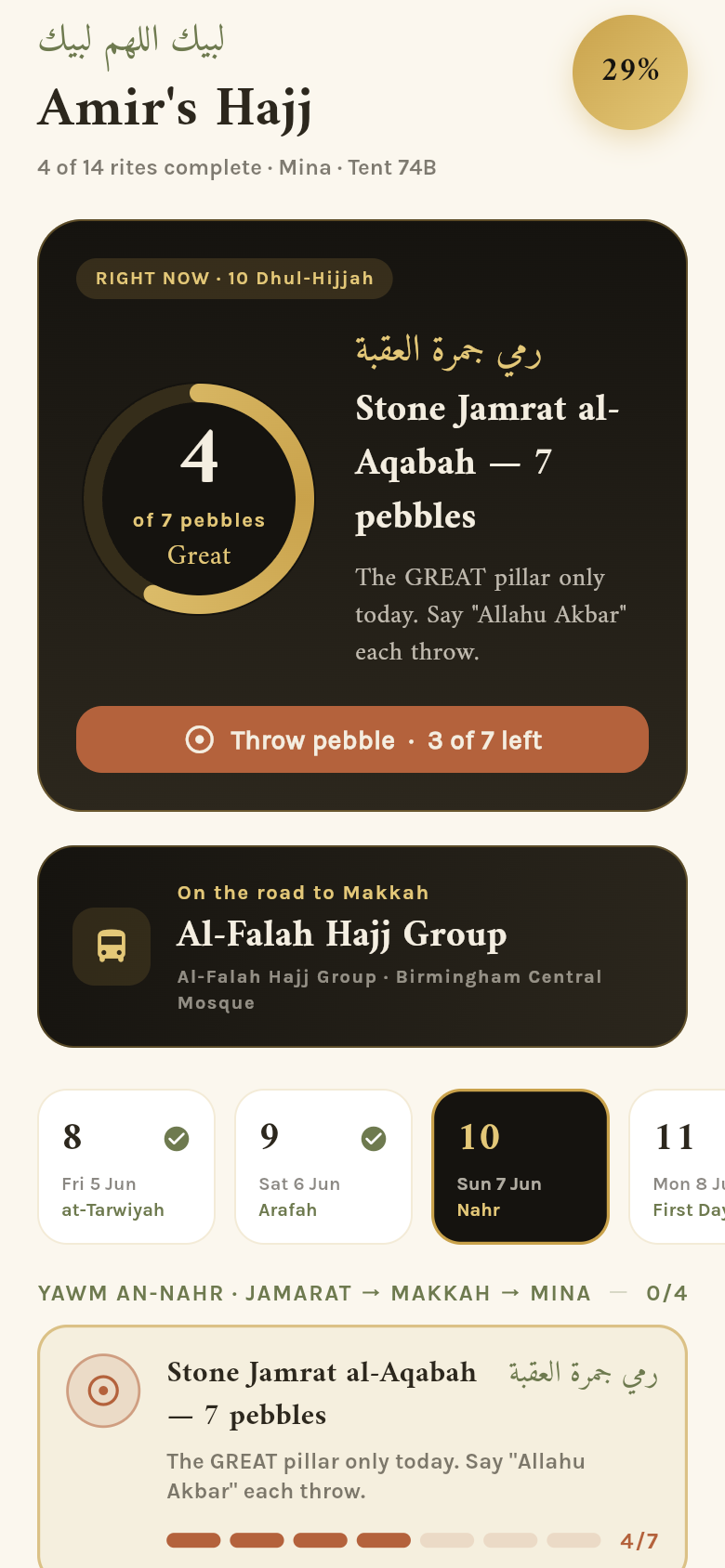
The plain of Mina is loud, crowded, and disorienting in the best possible way. You are surrounded by two million people all moving with the same intent, and the rites come at you faster than any printed itinerary can keep up with. Which of the three Jamarat pillars is next? Have you thrown six pebbles or seven? What time does the Al-Falah coach leave? Holding a laminated schedule in one hand while counting stones in the other, in the heat and the press of bodies, is genuinely hard.
Hajj Steps is a small, focused app built for exactly this moment. It was built from a single idea, for a specific person: Amir, a first-time pilgrim from Manchester, travelling with the Al-Falah group, staying in Mina Tent 74B. Everything in the app serves that one pilgrim on those five extraordinary days.
Live demo
One screen, one task
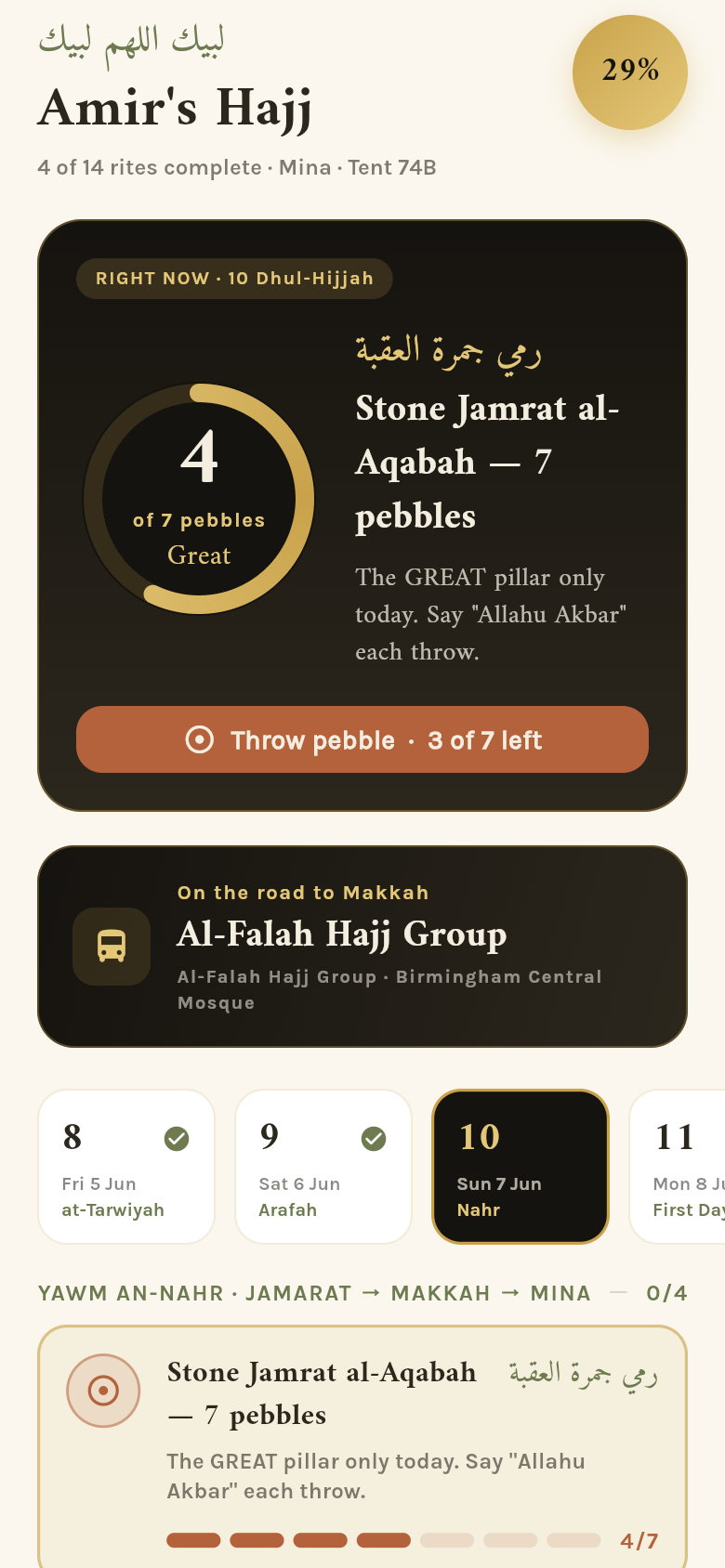
Open the app and you see the current rite, front and centre. Not a long list, not a calendar, not a menu to navigate. The active step fills the screen: the pillar name, a live count of pebbles thrown out of seven, and a large tap target to register each one. When the seventh pebble is confirmed, the rite closes and the next one steps forward automatically.
This single-focus design is the whole point. On a crowded causeway, you should be able to glance at your phone for two seconds, confirm you are on the right pillar, and put it back in your pocket. Try it in the demo below, the app opens mid-journey, partway through the Tashriq days, so you can feel what it is like to pick up from where you left off rather than starting from a blank slate.
The stoning order, laid out in full
The Jamarat ritual is precise in a way that surprises many first-timers. Three pillars, in a fixed small-to-great order, exactly seven pebbles each, repeated across multiple days, with different obligations on Nahr versus the Tashriq days. Getting the sequence wrong, or miscounting, can require a penalty sacrifice (dam), which is not something anyone wants to discover after the fact.
Swipe past the active rite and you get the full five-day schedule: Tarwiyah, Arafah, the stoning on Nahr, and the two Tashriq days, each broken into its individual steps with the pillar name and pebble count noted. It is the same information as the printed group itinerary, but organised around what you actually need to do right now, not around what day of the month it is.
Each completed rite is ticked and saved locally. The app holds its state fully offline, so a dropped signal on the plain, which is almost certain, changes nothing. Your progress is yours and it stays put.
The coach clock at the bottom
Guided Hajj groups run on tight schedules. The Al-Falah coach from Birmingham has a departure time from Mina that Amir absolutely cannot miss, because missing it means finding your own way back to Makkah through one of the busiest transit situations on earth. The app shows a quiet countdown to that departure at the bottom of the screen, always visible, never intrusive.
It is a small feature and it matters more than it looks. The rites themselves are spiritually absorbing, time moves differently in Mina, and a persistent clock that does not require you to open a separate app or unlock your phone is the kind of thing you are grateful for precisely because you forgot you needed it.
Built from one sentence
Amir's situation, first-time pilgrim, travelling from Manchester, Tent 74B, Al-Falah group, the specific anxiety about the Jamarat order, was described in a single prompt. The app that came back handles all of it: the ritual sequence, the pebble tally, the offline persistence, and the coach departure countdown, seeded with real mid-journey progress so it never feels like an empty form waiting to be filled in.
That is the thing worth noting. This is not a generic pilgrimage app designed for everyone. It is a specific tool for a specific journey, and the specificity is what makes it useful. You can tap through the Jamarat steps in the demo and see exactly how the pebble counter advances, how the completed rites stack up, and how the day-by-day schedule reads when you know which tent you are sleeping in.
What a personal ritual tracker can be
There are big Hajj apps with maps, prayer times, hotel bookings, and social feeds. Hajj Steps is none of those things. It is a private, quiet counter that knows exactly where you are in the rites and keeps one eye on the clock for you. It does not ask for an account, does not require a connection, and does not try to do anything beyond the five days it was made for.
If you are planning Hajj and travelling with a group, the details that matter, your tent number, your coach time, your group's itinerary, belong in the tool you carry with you. A tracker that knows those details is a different thing entirely from a generic checklist downloaded from an app store.
39
files in the build
40.0 MB
app bundle
Flutter Web
runs in any browser
Build your own ritual companion
Whether you are organising a Hajj group, tracking a religious observance, or managing any process where order and count both matter, describe your specific situation and get a working tool in minutes.