
sleep
Hinterhof Ruhe: A Noise Diary for Day-Sleeping Shift Workers
A Charité night nurse built a simple courtyard noise tracker to find the real quiet windows in her Neukölln flat. Here's what it does and why it works.
Artem
Founder
· 4 min read
Mia finishes her night shift at Charité at 07:15, takes the U8 home to Neukölln, and is in bed by 08:00. By 08:30 the drilling starts. By 09:00 the Kita downstairs is in full morning chaos. The bin lorry usually gets her around 07:45, right as she is drifting off. She has been working nights for four years, and she still cannot tell you with confidence when her flat is actually quiet.
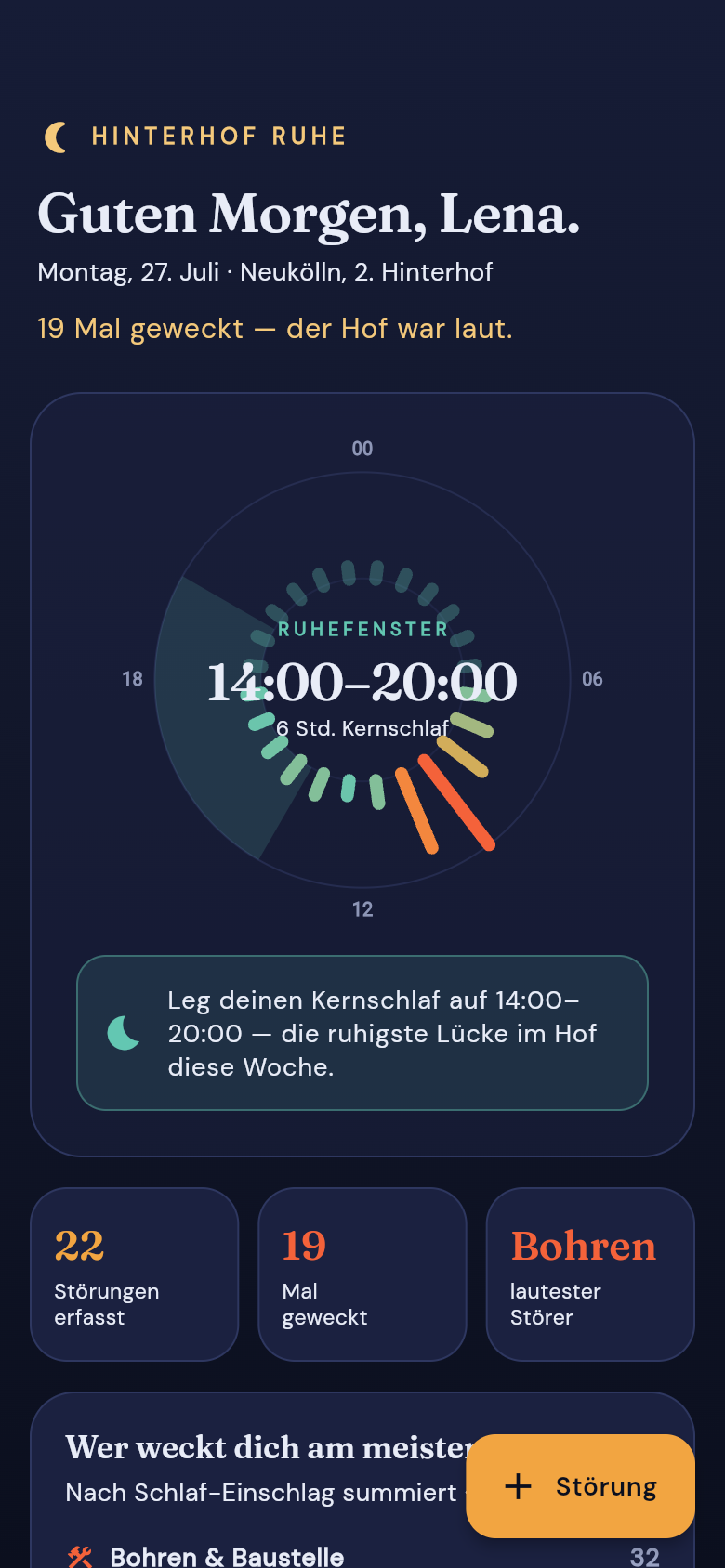
Hinterhof Ruhe is a small, focused app she had built from that frustration: log the disturbances as they happen, see the pattern across the day, and get a plain recommendation for the best sleep block. Try it in the phone frame below — it opens with seeded data so the charts are useful immediately.
Live demo
The problem with Hinterhof noise is that it is predictable, but only in hindsight
Berlin Altbau courtyards are acoustic funnels. Drilling from a Baustelle three buildings away bounces off the plaster walls and arrives in a first-floor bedroom at roughly the same volume as drilling next door. Kita drop-off peaks at 08:45 to 09:15. Bin collections run a fixed route, usually 06:45 to 07:30 in Neukölln. Construction permits typically allow work from 08:00 to 20:00 on weekdays.
The patterns are there. The problem is that no one writes them down consistently, so they live only as vague impressions: 'it gets quieter around lunchtime, maybe?' Hinterhof Ruhe exists to turn that vague impression into a number.
Logging a disturbance takes about ten seconds
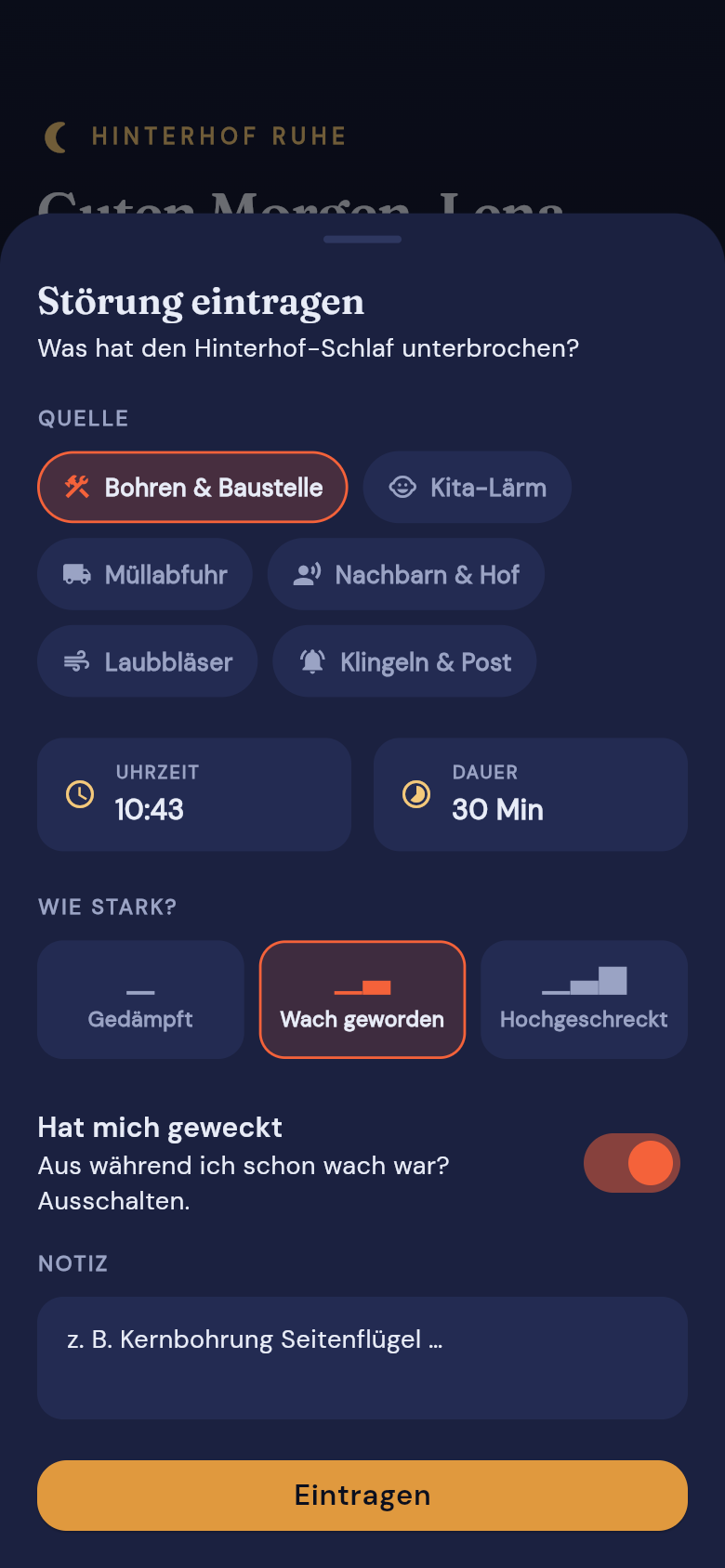
The log screen is the first thing you see. Tap the source — Drilling, Kita, Bin lorry, Traffic, Neighbours, or Other — pick a loudness from 1 to 5, note whether it actually woke you, and optionally add a line of text. The timestamp is filled automatically. That is it. The point is to be fast enough that you do it half-awake at 08:47 before pulling the pillow back over your head.
Over a few days, that stream of quick taps fills in the 24-hour chart on the analysis screen. Each hour gets a noise score. The quiet troughs become obvious — the visual makes the case that a week of impressions never quite does. Scroll through the demo in the frame and tap a few log entries to see how the chart updates.
The quiet-window recommendation is the feature that earns its keep
Below the hourly chart, the app identifies the least-noisy consecutive block long enough to matter — six hours by default, adjustable down to four. It states the recommendation plainly: 'Your quietest window is 11:00 to 17:00. Average noise score: 1.2.' No hedging, no caveats. If the data changes — a new Baustelle starts up, the Kita noise drops after summer holidays — the recommendation shifts on the next recalculation.
For a nurse on a rotating shift, this is actionable in a way that a generic 'sleep hygiene tips' article is not. It tells her whether to go to bed immediately after arriving home and bank a few hours before the drilling starts, or whether to stay up, do her errands, and sleep through the early afternoon. Those are meaningfully different schedules, and the right answer depends on her specific building, not on general advice.
Knowing which source costs you the most sleep changes what you do about it
The source ranking screen sorts disturbances by total sleep impact: number of incidents multiplied by average loudness, weighted by whether the incident woke you. For many Hinterhof sleepers, drilling ranks first by loudness but bin lorries rank first by sleep disruption, because they land in the first hour of sleep when waking is most disruptive.
That distinction matters because the responses are different. You cannot stop drilling, but you can write to the Bauherr to ask for the permit window, and knowing exactly which days and hours the noise runs gives that letter teeth. For bin lorries on a fixed route, you can simply put in earplugs before 07:00 on collection days. The app does not tell you what to do with the ranking, but it gives you the information to decide.
Offline-first, no account, nothing to configure
Hinterhof Ruhe works entirely on device. There is no login, no cloud sync, no subscription. The seeded data that loads on first open is realistic — a week of Neukölln courtyard noise with the typical morning spike and the midday trough — so the charts are informative before you have logged a single real disturbance. You can start treating the recommendation as provisional guidance from day one, then watch it sharpen as your own data comes in.
The app stores everything locally. If you want to use the noise log in a dispute with a landlord or a Bezirksamt complaint about a Baustelle, you can export the log as a plain list. Nothing leaves your phone otherwise.
39
files in the build
41.0 MB
app bundle
Flutter Web
runs in any browser
Have a specific problem that deserves its own tool?
Hinterhof Ruhe went from a one-sentence idea to a working app in a single session. If you have a problem that is too specific for a general app and too small to commission custom software, describe it and we will build it for you.