
health tracking
Symptom Thread: Finally See What Triggers Your Worst Days
A lightweight daily log that ranks your personal triggers by severity, so you arrive at appointments with real patterns instead of guesses.
Artem
Founder
· 5 min read
You already suspect that Tuesday's migraine had something to do with Monday's terrible sleep, or that your gut flares up a day after stress peaks. The problem is that suspicion is hard to defend in a doctor's office. By the time your appointment arrives, the specific days have blurred together, and 'I think stress might be a factor' is all you have to show for months of suffering.
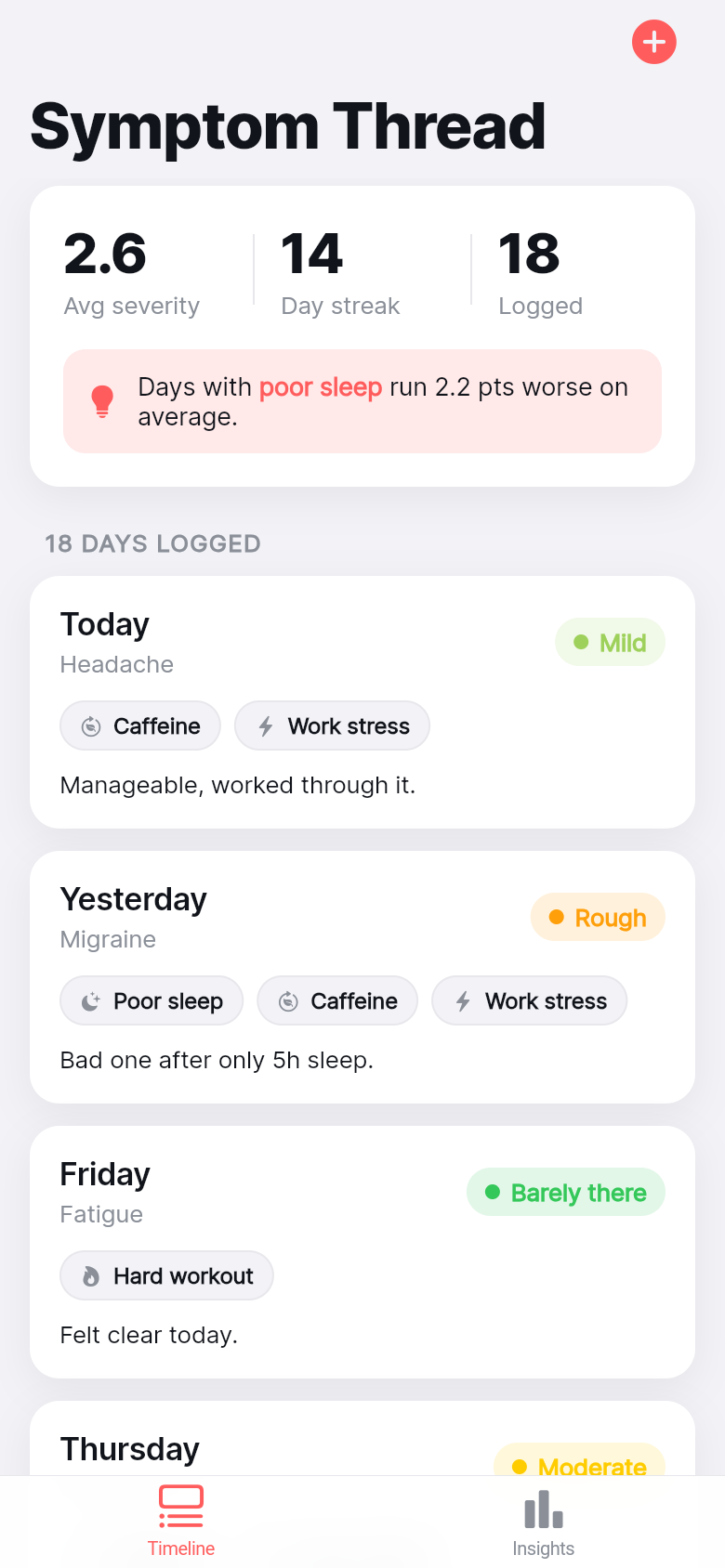
Symptom Thread is a simple daily log built around one idea: if you record just three things each day, the app can do the analysis for you. Tap in a severity rating, your main symptom, and whichever trigger chips apply, and over two weeks a clear picture starts to form. Give the embedded app below a try right now, and then we'll walk through how it works.
Live demo
Logging in under ten seconds
Most symptom apps fail because filling them in feels like a chore. Symptom Thread keeps the daily entry to three decisions: how bad was today on a 1 to 5 scale, what was the main symptom (headache, gut pain, skin flare, joint ache), and which triggers were present. The triggers are tappable chips, not free-text fields, so you're never staring at a blank box at 10 pm wondering how to describe your afternoon.
The app opens to today's entry every time, and it never shows you an empty or intimidating first screen. If you've already logged today, you see your entry. If not, the form is right there. Nothing to navigate, nothing to remember. That friction-free routine is what keeps paper diaries and heavier apps from sticking.
What the trigger rankings actually tell you
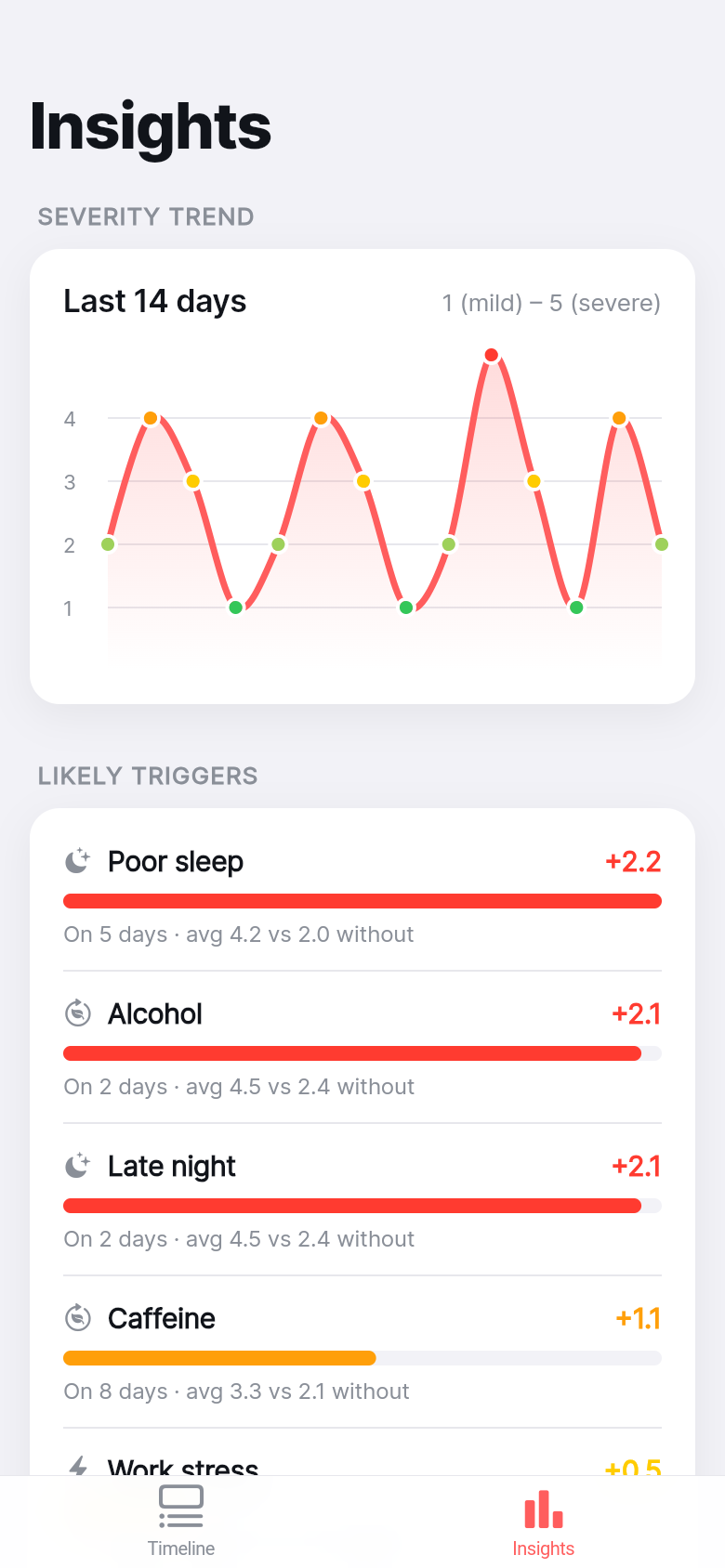
The most useful screen in the app is the trigger analysis. For each tag you've ever logged, Symptom Thread calculates the average severity on days when that trigger was present versus days when it wasn't. The difference, the 'lift', is what gets ranked. If your worst days consistently coincide with poor sleep, that tag floats to the top. If stress appears constantly but your severity is the same regardless, it sits lower.
This matters because our instinct is to blame the most memorable triggers, not the most statistically consistent ones. You might vividly remember the meal before a bad flare, but if bad sleep appears on nine of your ten worst days, that's the signal worth bringing to a specialist. The app doesn't diagnose anything, but it hands you a ranked list of correlations you can actually point to.
Scroll through the trigger rankings in the demo above. After a few logged days, you'll see the pattern start to form. The longer you use it, the cleaner the signal.
The 14-day trend line as a gut check
Numbers in a list are useful, but a trend line tells a different story. The 14-day severity chart shows whether things are getting better, worse, or cycling in a way that matches something in your life, a stressful work period, a dietary change, a new medication. When you're in the middle of a rough patch it's hard to tell if you're improving or not. The chart makes that visible.
It's also genuinely useful to screenshot and bring to an appointment. Instead of describing how you've been feeling for the past two weeks, you show a line with peaks and valleys, and you can point to the specific days where severity spiked. That shifts the conversation from impressions to evidence.
Private by design, no account required
Health data is personal, and the app treats it that way. Everything stays on your device. There's no account to create, no cloud sync, no server receiving your entries. You open it, log your day, and close it. That also means it works completely offline, which matters when you're having a bad day and the last thing you want is a spinner.
This isn't just a privacy stance, it removes a real barrier to starting. There's nothing to set up. No email confirmation, no onboarding survey asking about your diagnosis. You tap in a severity and a trigger, and you've already started building a log that will be useful to you.
Who gets the most out of it
Symptom Thread is built for people with recurring, trigger-sensitive conditions: chronic migraine, IBS and gut issues, eczema and psoriasis, lupus or other autoimmune flares, and similar conditions where what you eat, how you sleep, and how stressed you are can shift how bad a day gets. It's not a replacement for medical care, and it doesn't try to be. It's the kind of lightweight daily habit that specialists often recommend but rarely give you a good tool for.
If you've ever been told to 'keep a trigger diary' and abandoned a notebook within a week, this is the version that might actually stick. The entry is fast enough to do tired, and the analysis gives you a reason to keep going: you're not just recording misery, you're building evidence.
39
files in the build
40.1 MB
app bundle
Flutter Web
runs in any browser
Have an idea for a tool like this?
Symptom Thread started as a one-line idea and became a working app in minutes. If you've been putting off building a small tool because it seemed too complicated or expensive, that barrier is gone.