
food journal
Dish Diary: Your Private Log of Every Meal Worth Remembering
A fast, offline taste journal that tracks what you cooked or ate, how good it was, and whether you'd make it again — so your best meals are never forgotten.
Artem
Founder
· 5 min read
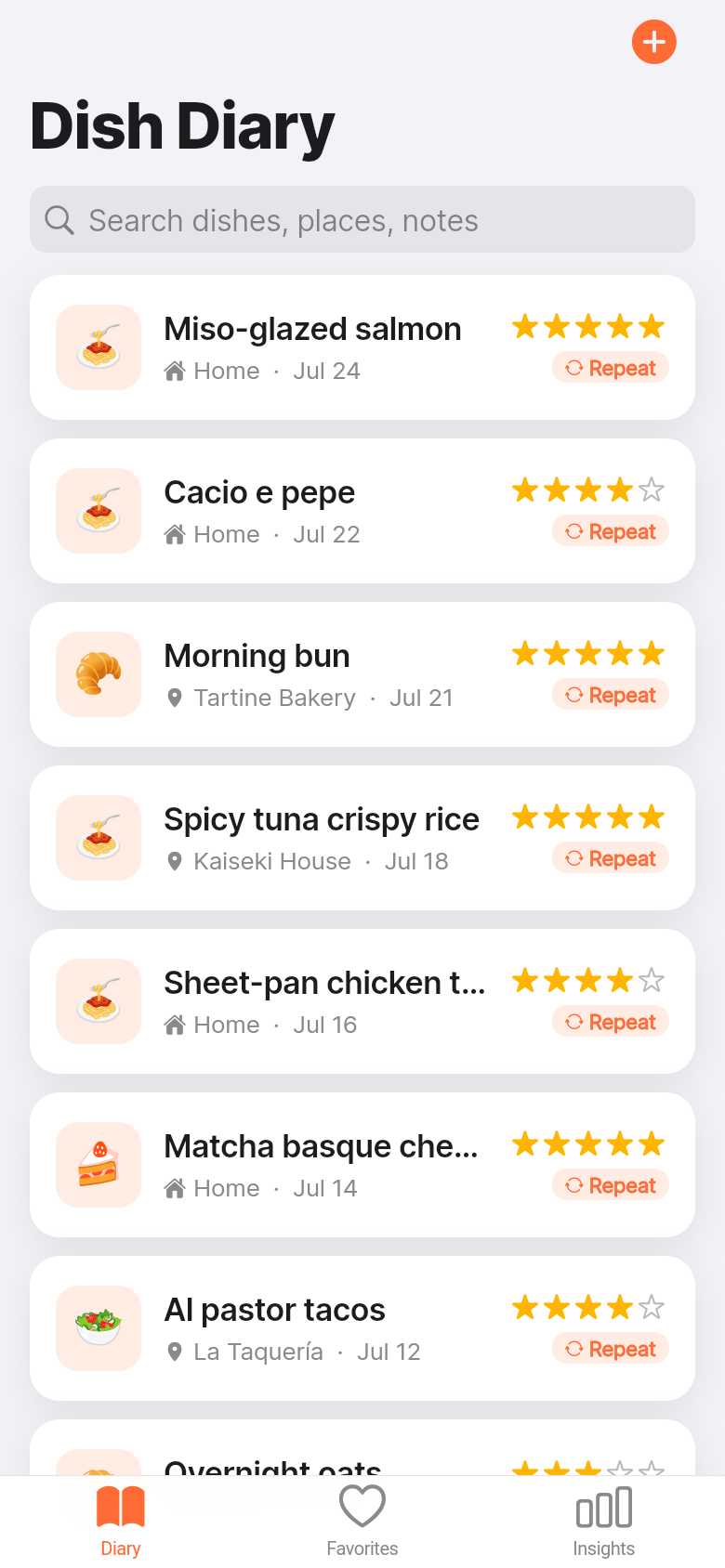
You made that roasted chicken with the crispy skin on a random Wednesday and it was genuinely one of the best things you've eaten all year. Three weeks later you're standing in the kitchen trying to remember what you did differently, and you can't. That's the gap Dish Diary fills: a simple, private log where you record what you ate, how good it was, and whether it's worth repeating.
This isn't a recipe manager, and it's not a social restaurant reviewer. It's a personal taste journal that lives on your phone, works offline, and answers the one question that actually matters at 5pm on a Thursday: what have I made before that I actually loved?
Live demo
Logging a Dish Takes About Ten Seconds
The app opens straight to your log. Tap the add button, type the dish name, pick a star rating from one to five, choose whether you cooked it at home or ate it out, and optionally add a place and a short note. That's it. No required fields beyond the name and rating. No account, no upload, no waiting.
The note field is where the real value accumulates over time. 'Added more lemon than the recipe said and it was better.' 'The Thai place on Oak Street, ask for extra chili.' 'Kids hated it, I loved it.' These tiny details are exactly what you forget and exactly what you want back six months later. Dish Diary just gives them a home.
Try adding a dish in the live demo above. You'll see how fast the flow is: the form is minimal, the keyboard doesn't get in the way, and the entry drops into your log immediately.
Finding a Past Favorite Is Instant
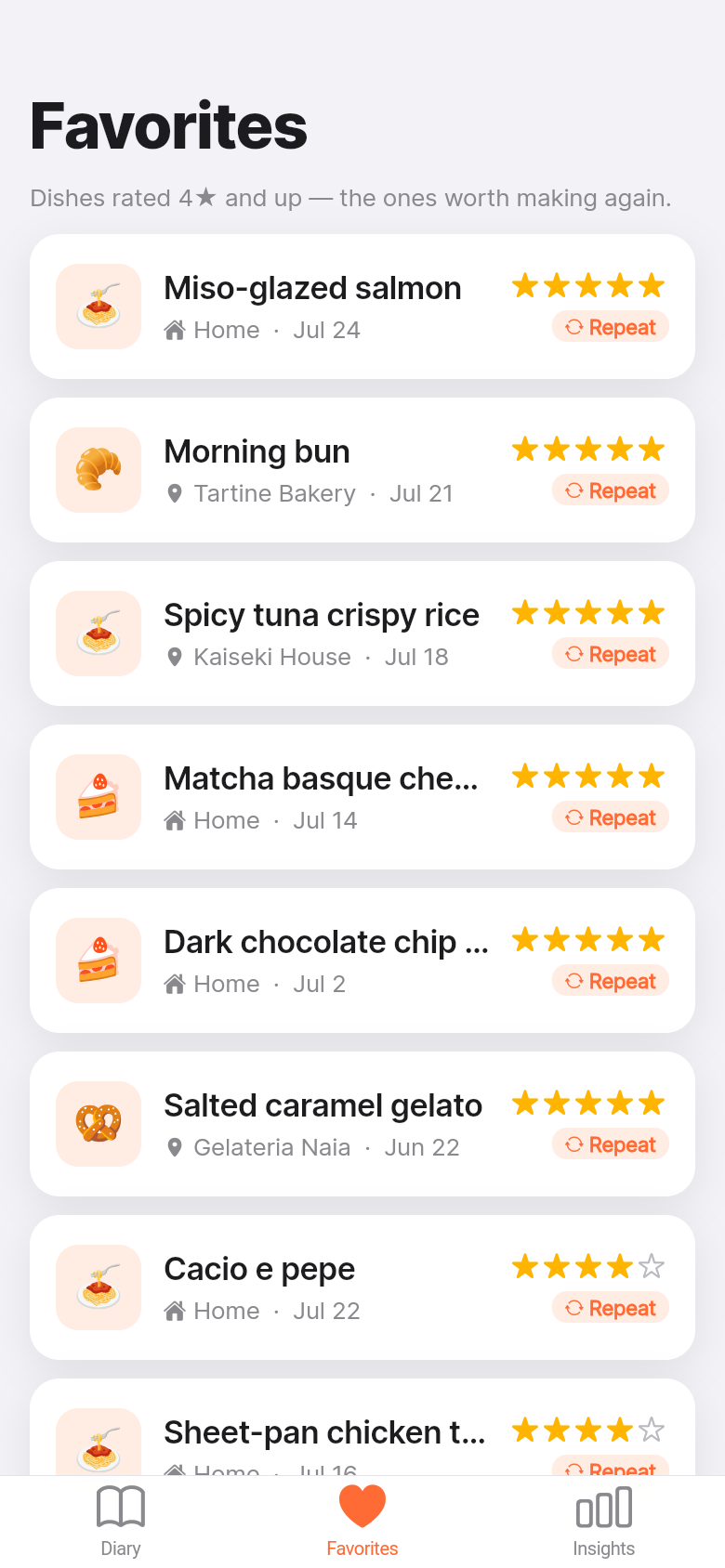
The search bar at the top of your log isn't just a name matcher. It searches across dish names, places, categories, and your own notes, so typing 'salmon' surfaces every salmon dish you've logged whether it was a weeknight fillet at home or the cedar-plank version at that restaurant you can never remember the name of.
You can also filter by category, which is useful once your log grows. Tap 'Pasta' and see every pasta dish, ranked by when you added it or by rating. The Favorites tab does one specific job: it shows only 4-star and 5-star entries, the dishes you explicitly flagged as worth repeating. When someone asks what you should make for dinner, that tab is a better answer than scrolling a recipe app you haven't cooked from yet.
Scroll through the Favorites view in the demo. If you've added a few dishes, you'll already see the pattern: your own ratings tell you more about what you'll enjoy than any recommendation algorithm built on other people's preferences.
Your Data Tells You Things About Yourself
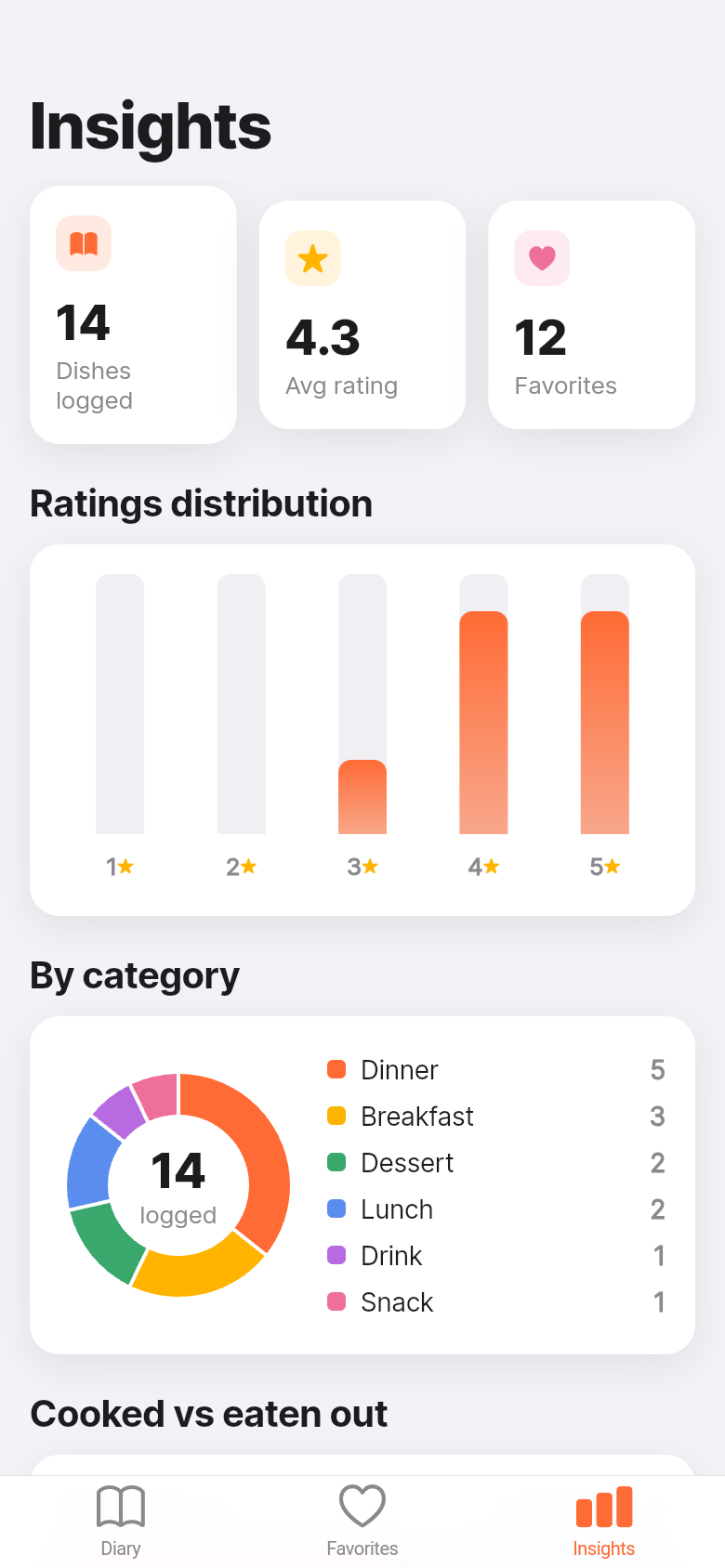
The insights panel surfaces three things: your average rating across all entries, how your ratings distribute from one to five stars, and the breakdown of dishes by category. None of it is complicated, but taken together it's a small mirror on your actual eating habits.
A high average means you're good at cooking what you like, or you're generous with stars. A cluster of 3s with almost no 4s or 5s might mean you've been cooking things out of obligation rather than enthusiasm. A category breakdown heavy on 'Italian' and light on everything else confirms what you already suspected. The app doesn't editorialize, it just shows you the numbers.
Because Dish Diary ships with seeded data on first open, the insights panel has something real to show immediately. You're not staring at empty charts trying to imagine what the app will feel like once it's full. You can see the shape of a log in use and decide whether it matches how you want to keep yours.
Private by Design, No Account Required
Restaurant review apps are built for audiences. They want you to post publicly, earn followers, and contribute to a collective rating system. That's fine for a different purpose, but it's exactly the wrong model for logging the dinner you cobbled together from leftovers on a Tuesday, or the dish you wanted to love but gave two stars because honestly it was a bit bland.
Dish Diary stores everything locally on the device. There's no signup, no cloud sync, no social feed. Your log is yours, visible only to you, and it works just as well with no internet connection as with one. For a use case that's fundamentally personal, that's the right call.
Built From a Single Idea
Dish Diary started as a one-sentence brief: a private taste journal for home cooks who want to remember and re-make their best meals. From that description, Leanfinit generated a working app with a full data model, search, filtering, a favorites view, and an insights panel. The whole thing runs offline, ships with believable starter data, and opens ready to use.
The idea behind Leanfinit is that most useful tools don't need a development team or a six-month roadmap. A clear problem, a specific audience, and a focused feature set are enough to build something real. Dish Diary is a straightforward example: one gap in how people track their food, one clean solution, built fast from a single prompt.
39
files in the build
40.2 MB
app bundle
Flutter Web
runs in any browser
Have an idea for a tool of your own?
Describe it in a sentence and Leanfinit will build it. No code, no team, no waiting.