
parenting
House Points: A Chore Scoreboard That Pays Out on Sunday
Stop being the referee every evening. House Points turns dishes, bins, and homework into a live tally that decides Sunday pocket money — no arguments, no memory required.
Artem
Founder
· 4 min read
It's 7pm on a Wednesday and you've already asked twice about the bins. Zanele says she did them last week, Sipho is sure it's Thandi's turn, and you're standing in the kitchen trying to remember who actually did what four days ago. You give up, you do it yourself, and the evening ends with everyone a little annoyed.
House Points exists to remove you from that argument entirely. It's a shared scoreboard — built to live on a phone propped on the fridge — where every completed chore logs instantly as points, and Sunday morning the app simply announces how much pocket money each kid has earned. No negotiation, no memory, no nagging. The rules are set once; the scoreboard does the rest.
Live demo
A ranked board, the moment you open it
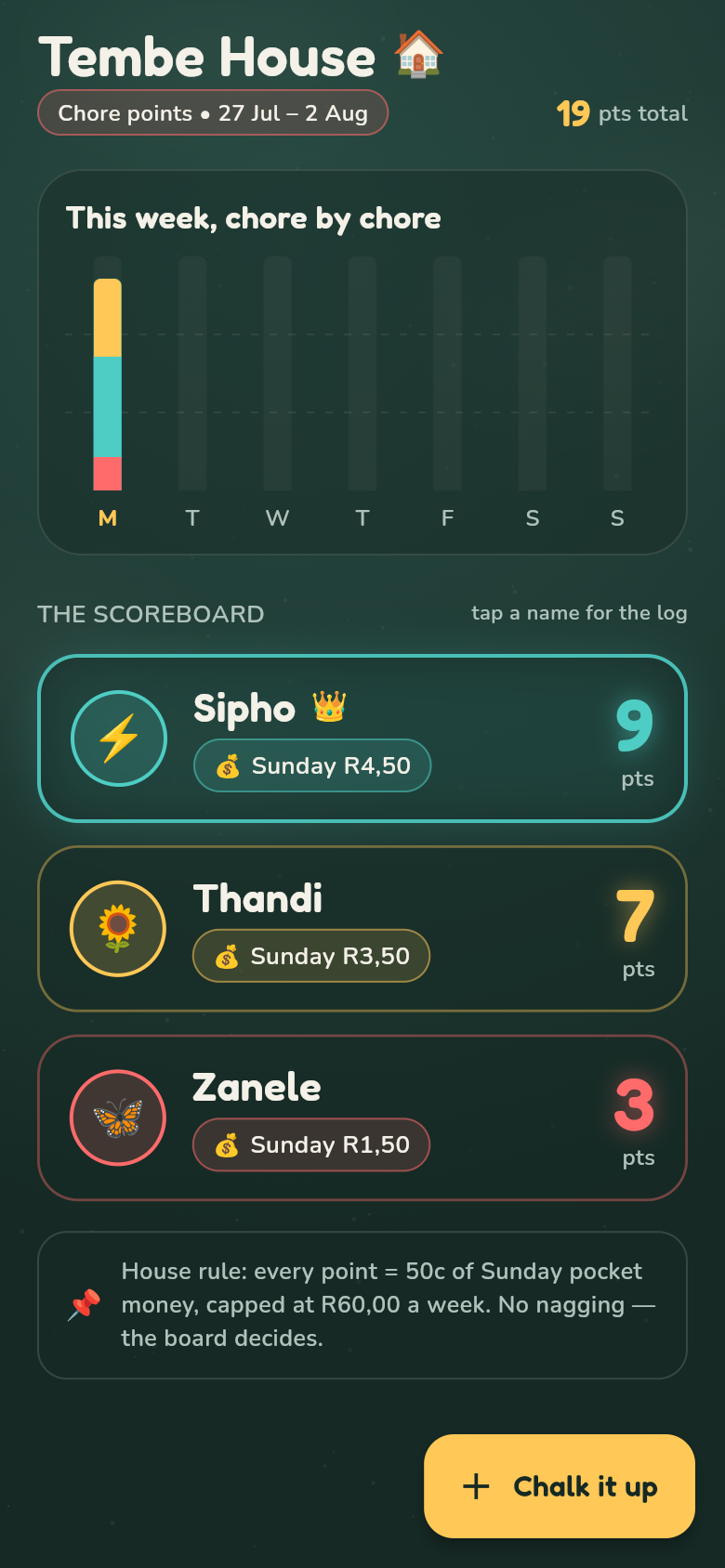
The first screen shows exactly what a fridge display should: all three kids, ranked by this week's points, with their Sunday payout already calculated underneath. There's no setup wizard to click through, no empty state asking you to add your first task. Zanele, Sipho, and Thandi are there from the start, with their tallies running live.
Try tapping on any name in the demo above. The scoreboard updates in real time, and you can immediately see how the Sunday number shifts with each logged chore. That instant feedback is actually the whole point, because kids notice a scoreboard in a way they never notice a parent's memory.
Logging a chore takes two taps
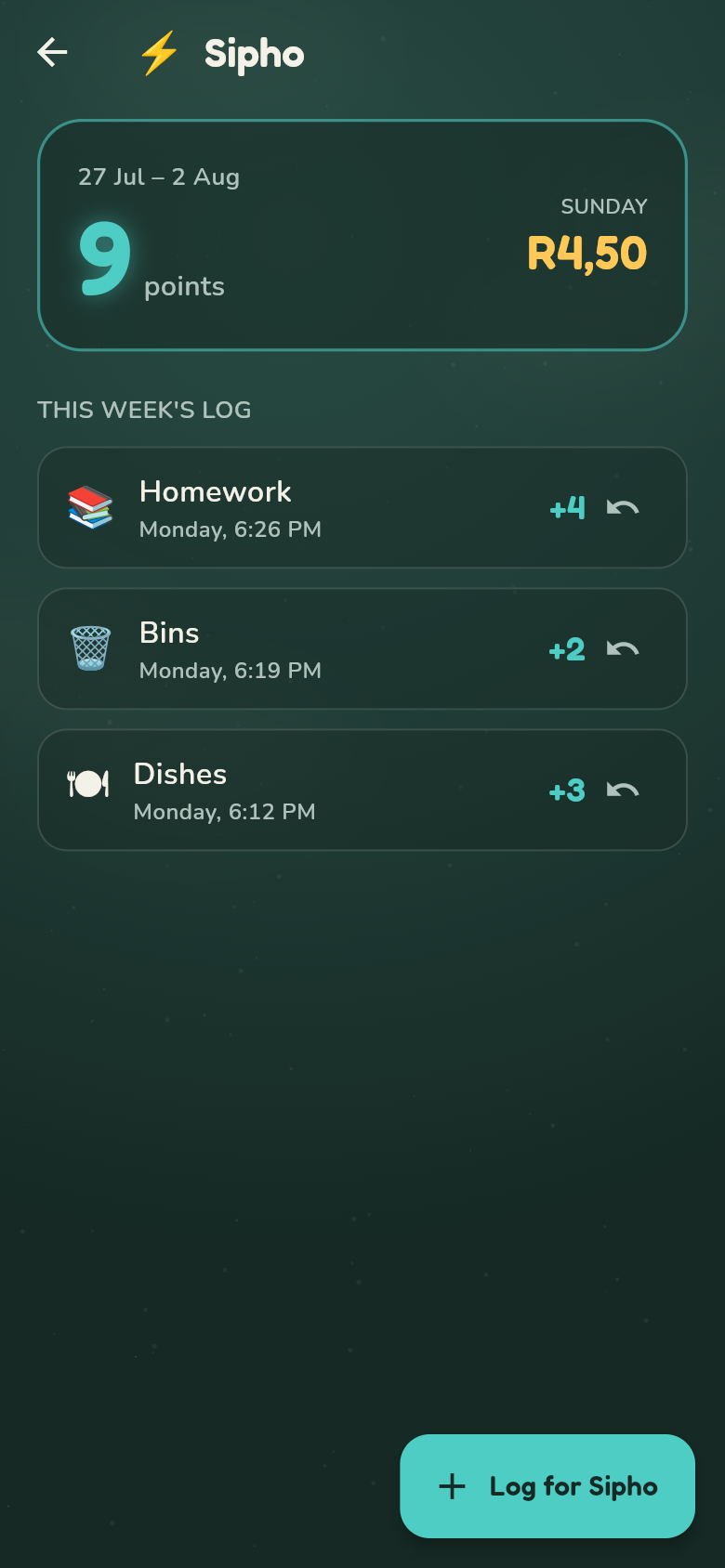
The logging flow is deliberately minimal. Tap the kid, tap the chore — dishes, bins, or homework — and the point lands on the board. That's it. The interaction is fast enough that a teenager can log it themselves on the way out of the kitchen, which means you're not the one updating the chart either.
Each chore carries a fixed point value, and points convert directly to a money figure based on a house rule that's visible to everyone. There's no ambiguity about what a week of doing the bins is worth — the rule is transparent, the maths is automatic, and the Sunday payout is simply what the board says it is. It's hard to argue with a number you watched accumulate in real time.
Monday to Sunday, then it resets
The week runs Monday to Sunday. On Sunday, the totals cash out — each kid's points translate into their allowance for that week — and then the board resets to zero for the new week. There's a satisfying clarity to that rhythm: a fresh start every Monday, a settled payout every Sunday morning.
The reset also solves one of the subtle problems with paper charts: old points accumulating indefinitely until no one trusts the numbers. Here, the scope is always just this week. Last Wednesday's dishes are history; what matters is what's on the board right now.
Built for the fridge, works offline
The app stores everything locally on the device and works with no internet connection at all. That matters for a phone that lives on a kitchen counter: it doesn't need a wifi signal to show the current scores, it doesn't log anyone out, and it doesn't require an account to function. Pick it up, glance at the board, put it down.
Because it's a shared family device rather than a personal phone, the design skips individual logins entirely. Anyone in the house can log a chore or check the standings — which also means the kids have a genuine reason to open it and care about what it shows. The scoreboard only works as a motivator if everyone can see it.
Why a specific tool beats a general one
There are spreadsheets, notes apps, and chore-tracking services that could theoretically do this. But a spreadsheet on a shared phone requires someone to maintain it, and a general chore app tends to have enough settings and features that it becomes another thing to manage.
House Points does one thing: it runs a Mon–Sun points race for your specific kids and your specific chores, and it pays out on Sunday. The narrowness is the feature. This wasn't built for every family on earth — it was built for a parent with three teenagers who was done being the nightly referee, and that specificity is exactly what makes it feel right to use.
39
files in the build
40.2 MB
app bundle
Flutter Web
runs in any browser
Have a household problem that needs its own tool?
House Points started as a one-line idea — a chore scoreboard that decides Sunday pocket money. If you have a routine in your life that deserves its own simple, focused app, you can build it the same way.