
mental health
Reframe: A Private CBT Thought Record That Fits in Your Pocket
When a spiral starts, Reframe helps you slow down, name the thinking trap, and write a balanced thought you can reread the next time doubt creeps back.
Artem
Founder
· 5 min read
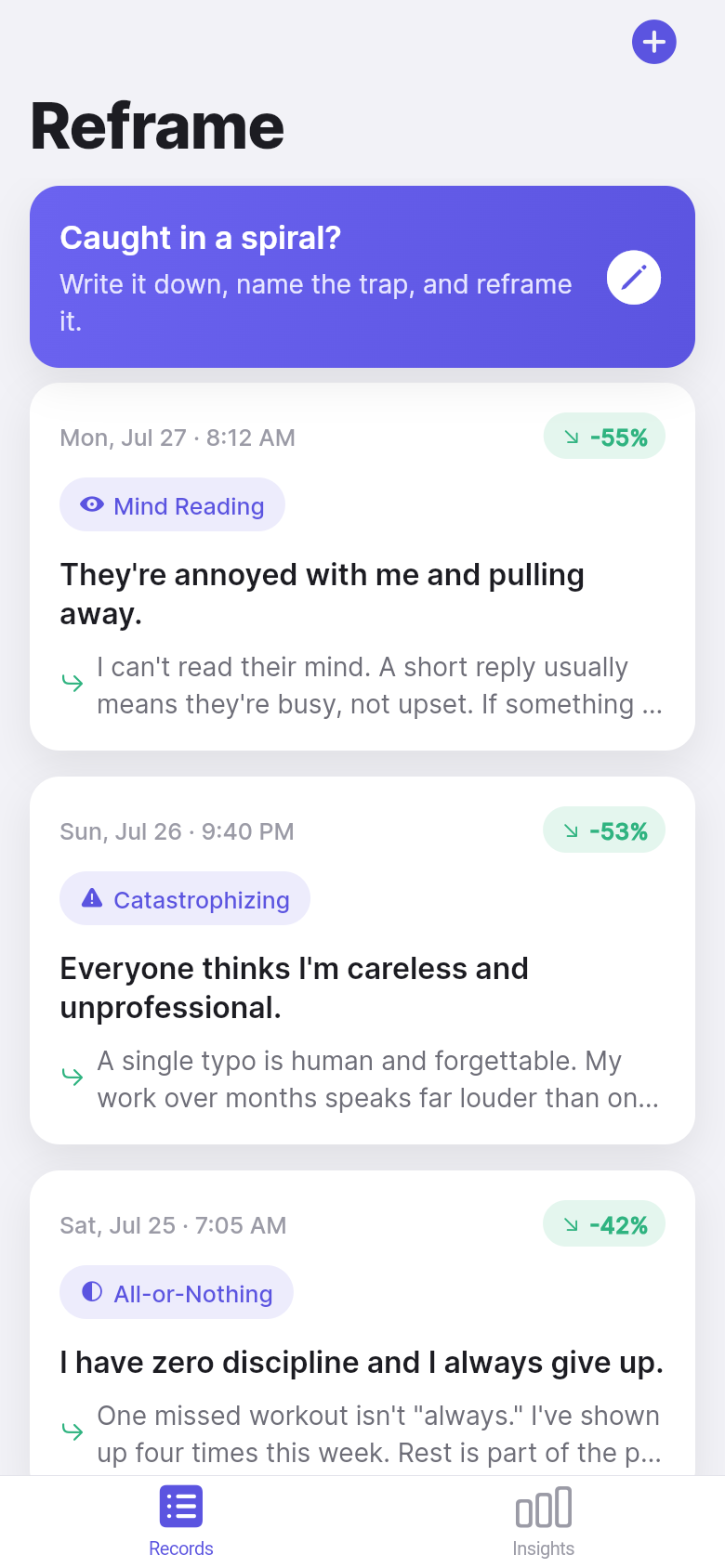
You know the moment. A critical thought lands, and within seconds it has expanded into something that feels absolutely true. Maybe you bombed a presentation, or a friend didn't reply, or you made a small mistake and your brain is already drawing sweeping conclusions. The thought feels urgent and real, and there's nowhere private, fast, or structured to put it.
Reframe is a small, offline app built around one of the most effective tools in cognitive behavioral therapy: the thought record. You write down what happened, name the distortion at work, and draft a more balanced version of the thought. Then you rate how much you believe the original thought before and after. Most people are surprised how much that number drops.
Live demo
What a thinking trap actually is
CBT research has catalogued the ways our minds reliably distort stressful situations. Catastrophizing turns a missed deadline into a career-ending failure. Mind reading assumes you know exactly what someone else thinks of you. All-or-nothing thinking splits a mostly good day into a total disaster because one thing went wrong. These aren't character flaws, they're patterns, and naming them is the first step to loosening their grip.
Reframe gives you a short list of the most common traps, with plain-English descriptions. When you're in the middle of a spiral, you don't have to remember terminology, you just recognize the shape of what's happening. Tapping the right label does something simple but useful: it creates a little distance between you and the thought. The thought is a pattern. Patterns can be examined.
One short sheet, start to finish
Open the app and you land on a calm, populated example so you never face a blank screen. Tap 'New record' and you work through four fields in order: the situation (just the facts of what happened), the automatic thought (what your brain immediately said about it), the thinking trap it falls into, and a balanced reframe you write yourself.
The reframe is the hardest part, and also the most valuable. Writing 'I made a mistake in one meeting' instead of 'I'm incompetent' is easy to say and hard to feel. But the act of writing it, in your own words, in your own moment, is different from reading someone else's advice. Before you finish, you rate how much you believe the original thought on a scale from zero to one hundred, then rate it again after writing the reframe. That before-and-after gap is often the first concrete evidence people have that their thinking is movable.
Try the live demo embedded above. Pick any situation on your mind, even a small one, and work through it. The whole thing takes under three minutes.
A journal you'll actually reread
Paper thought records are one of the most commonly assigned CBT exercises and one of the least completed. They get lost, feel awkward to carry, or pile up unseen in a notebook. Reframe keeps every record in a browsable journal on your device, private and offline, no account required. You can scroll back to a thought from last month and reread the reframe you wrote when you were calmer. That record becomes a resource, not just an exercise.
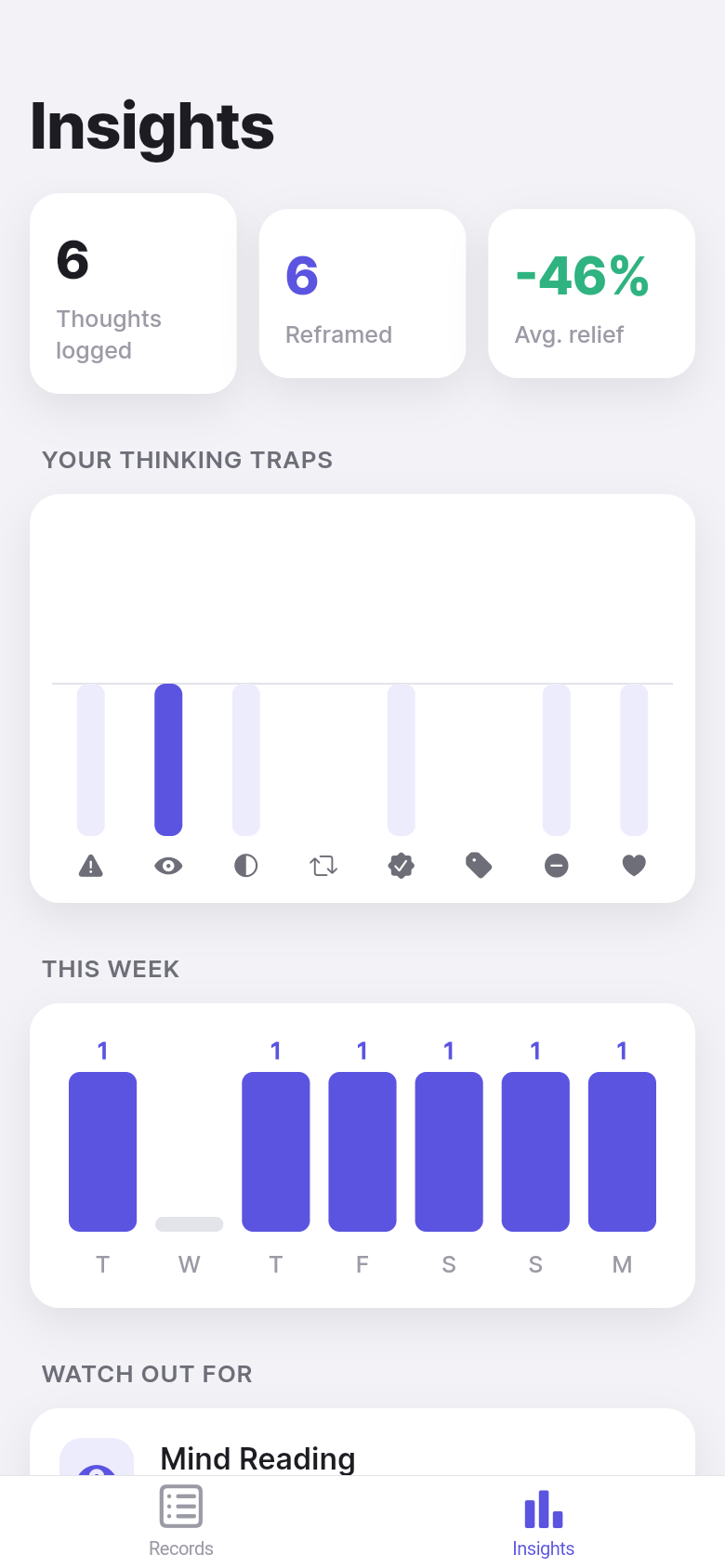
Over time, the app reflects your patterns back to you: which traps come up most, how active you've been week by week, and your average belief-shift across all records. Seeing 'catastrophizing' appear repeatedly isn't discouraging, it's useful. It's the same insight a therapist would spend several sessions surfacing, available to you between appointments or entirely on your own.
Built for the moment, not for a course
Most mental wellness apps ask you to commit to a program, complete modules, or build streaks. Reframe makes no such demands. It's designed for the specific moment when a difficult thought arrives and you need somewhere structured to put it. You can use it once a week or three times a day. There's no gamification, no push to share, no cloud sync asking for your email.
That's a deliberate choice. Anxiety and rumination often carry a layer of shame, and the last thing someone mid-spiral needs is friction or surveillance. Everything stays on your device. The app opens instantly, runs offline, and gets out of your way once you've finished the record.
If you're working with a therapist, Reframe fits naturally alongside that work, it's essentially a digital version of the thought records many therapists already assign. If you're exploring CBT on your own, it gives you the core practice without requiring you to read a textbook first.
From idea to working app
Reframe was built from a single-sentence description of the problem: people spiral on distorted thoughts and have no fast, private place to work through them. The app you're looking at, including the thinking-trap labels, the belief slider, the journal view, and the pattern summaries, came together from that starting point. No app store account, no backend, no sign-up flow.
That's the premise behind Leanfinit: if you have a specific problem you want to solve for yourself or your users, the gap between idea and working tool is a lot smaller than it used to be.
39
files in the build
40.1 MB
app bundle
Flutter Web
runs in any browser
Have a tool you wish existed?
Describe the problem in one sentence and see what gets built. No technical background needed, no subscription, no waiting.