
dia de muertos
Ofrenda Plan: Keeping Abuela's Seven-Level Altar Alive
One Oaxacan family's annual Día de Muertos ritual, encoded level by level so the next generation can build it exactly right, every year.
Artem
Founder
· 5 min read
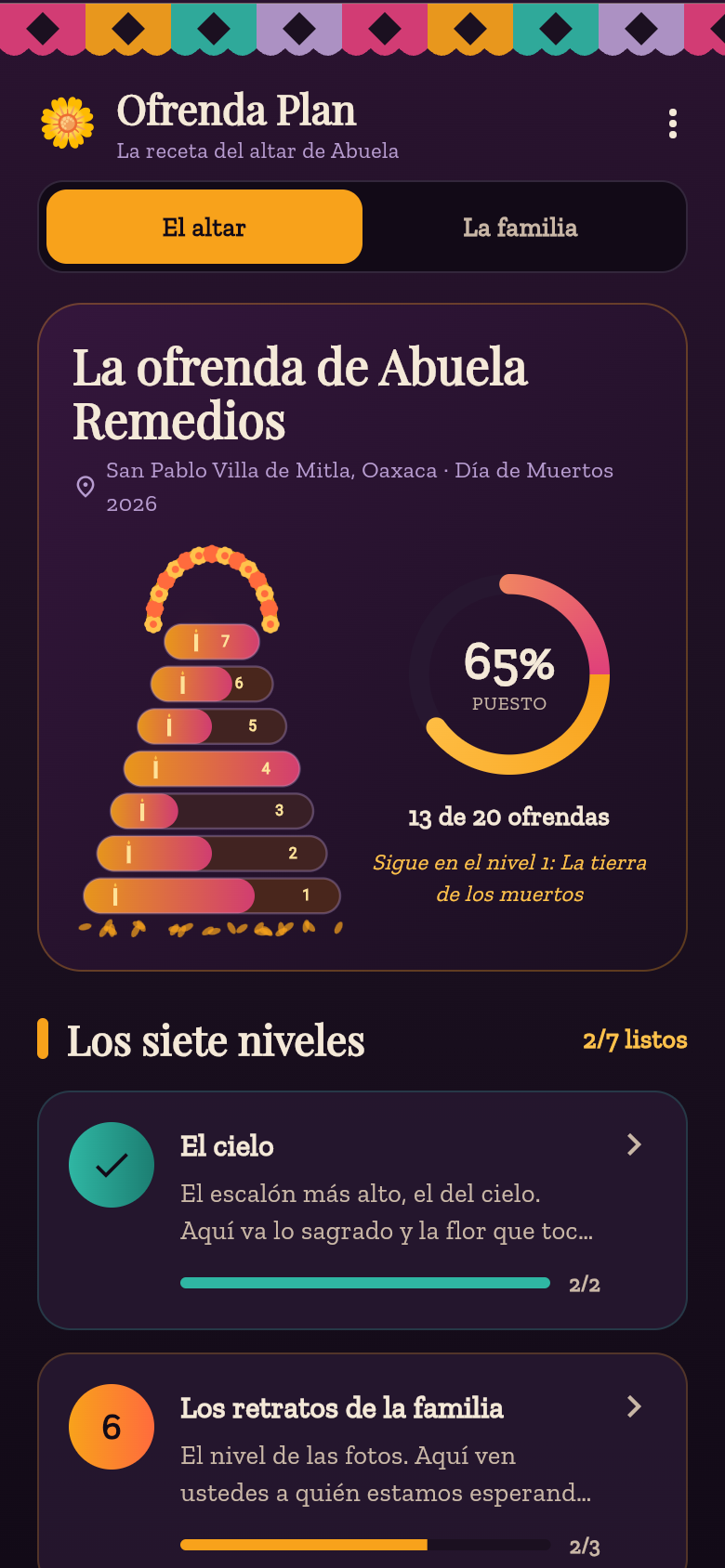
Abuela Remedios knows things nobody else knows. She knows that the second level holds the salt and water, that the cempasúchil petals must form a continuous path from the door, that the mole she sets out is the one her mother made, and that the photo of Tío Ernesto goes on the third tier because he died young. She has rebuilt this altar every November for fifty years, and every detail lives entirely in her memory.
Ofrenda Plan is a small app built to capture exactly that: one family's seven-level altar, named and described in their own words, with every candle, pan de muerto, and mezcal glass tied to the relative it honors. It is a living checklist you build together with the elder who holds the tradition, so the next generation can carry it forward when she is gone.
Live demo
Why a generic checklist is not enough
There are plenty of guides explaining what a Día de Muertos altar is. Most describe a universal template: seven levels, candles, water, food, flowers. None of them know that your family's sixth level holds the mezcal from the village distillery your grandfather preferred, or that the angelito bread is placed before anything else because that is how your great-grandmother did it in San Pablo Villa de Mitla.
The knowledge that matters is not the template. It is the deviation from the template, the specific dishes, the particular relatives, the order your family arrived at over generations. That is what Ofrenda Plan is designed to hold. Each level has a name and a meaning you write yourself, and each element within it is described in your family's language, not in the language of a how-to article.
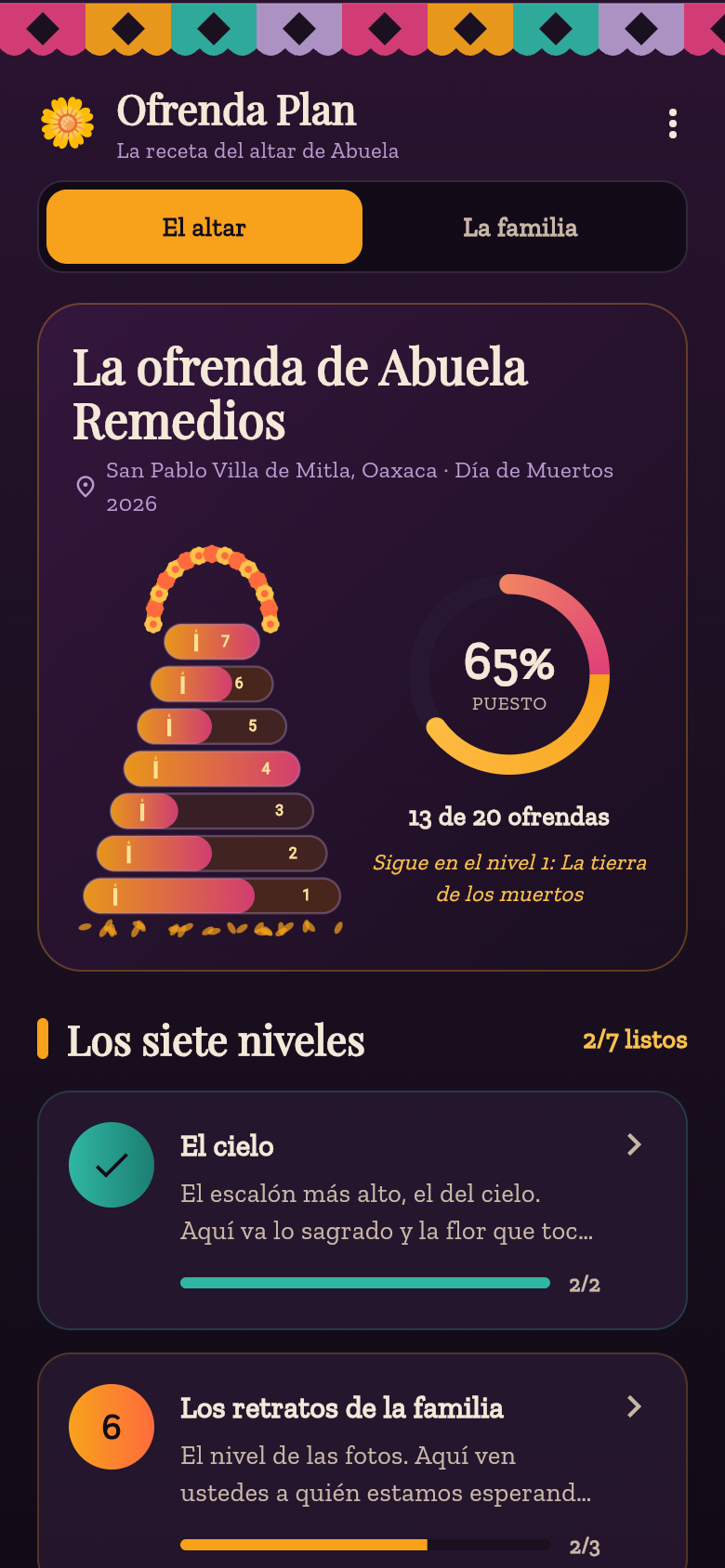
Building the altar together, screen by screen
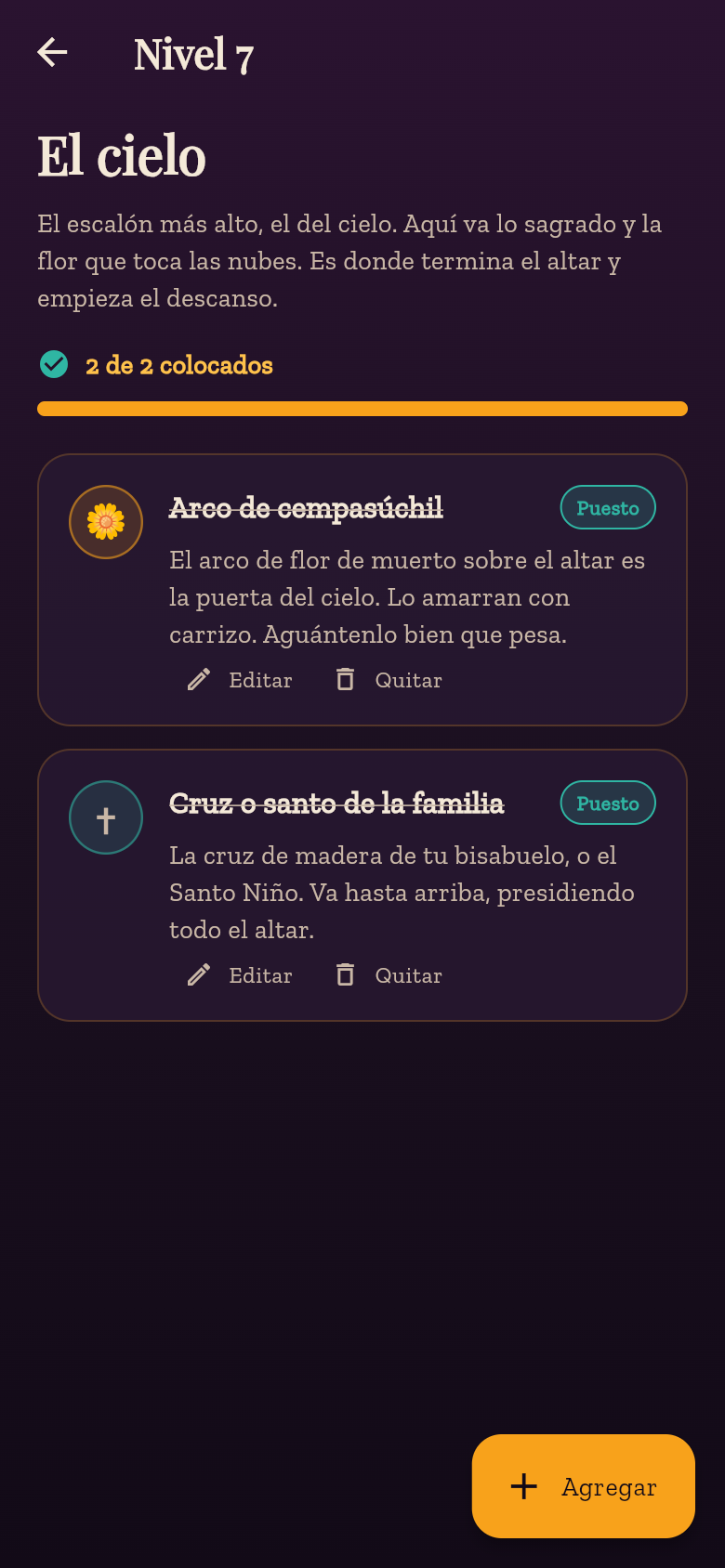
The app opens on the full seven-level structure. Tap any level and you see its name, what it represents, and the items that belong there. Next to each item is a checkbox. As you place the cempasúchil petals, light the copal, set out the pan de muerto, you tick them off. The progress bar for that level fills. When all seven are complete, the altar is done.
That sounds simple because it is. The ritual itself is not complicated; it is personal. The work Ofrenda Plan does is hold your version of it: the mole recipe your grandmother makes (not a link to a website, just the note that it takes three days and uses the dried chiles from the market in Tlacolula), the name of each difunto and the year they died, the offering they loved in life. You can open the difuntos gallery and read a remembrance for each person before you place their photo. That pause is part of the ritual too.
Try the live app in the phone frame beside this article. Navigate the levels, tap into a difunto's card, check off an item and watch the progress update. It takes about a minute to feel how the whole thing holds together.
The gallery of the difuntos
One section of the app is devoted entirely to the people being honored. Each card shows a name, the years of their life, a short remembrance written by the family, and the offering placed for them on the altar. For Abuela's altar that means Tío Ernesto, her parents, her husband, and a handful of others whose names younger relatives may not recognize without the prompt.
This is the part of the app that tends to become something families read on the day itself, not just during setup. The remembrances are short, a sentence or two, but they are the family's words. A child who never met their great-grandparents can read what the elder wrote and understand something real about them. That is a different thing from a photograph alone.
Offline and entirely yours
The app works without an internet connection and stores everything locally on the device. There is no account, no cloud sync, no subscription. The altar plan your family enters persists on that phone or tablet and can be brought out every November without any setup beyond opening the app.
That matters practically because altars are built over two or three days, sometimes in homes where the wifi is unreliable, always in the middle of other preparations. It matters in a different sense too: the content belongs to the family. The mole note, the remembrances, the specific ordering of the levels, none of that is sent anywhere. It is kept the way a handwritten notebook is kept.
Passing it on
The real audience for Ofrenda Plan is not Abuela Remedios. She already knows everything. The audience is her adult children, and their children, who will one day build this altar without her and will want to get it right.
The best use of the app is to sit with the elder while she still remembers clearly, let her dictate the level names and the element descriptions, add the difuntos one by one with the details she provides, and then hand her the phone so she can check that it looks right. That session, an hour at most, produces something that will outlast the conversation. The following November, and the one after that, the family opens the app and the altar your grandmother built is still there, level by level, waiting to be assembled again.
39
files in the build
40.5 MB
app bundle
Flutter Web
runs in any browser
Turn your family's tradition into an app
Whether it is an altar, a recipe, a ritual, or any practice your family does in a specific way for specific reasons, you can describe it in a sentence and have a working app to capture it within minutes.