
ramadan
My Ramadan Log: Prayers, Fasts, and a Khatm in 30 Nights
A quiet personal tracker for Finsbury Park mosque-goers who want to finish the Qur'an, keep every fast, and never lose count of a missed prayer across the whole month.
Artem
Founder
· 5 min read
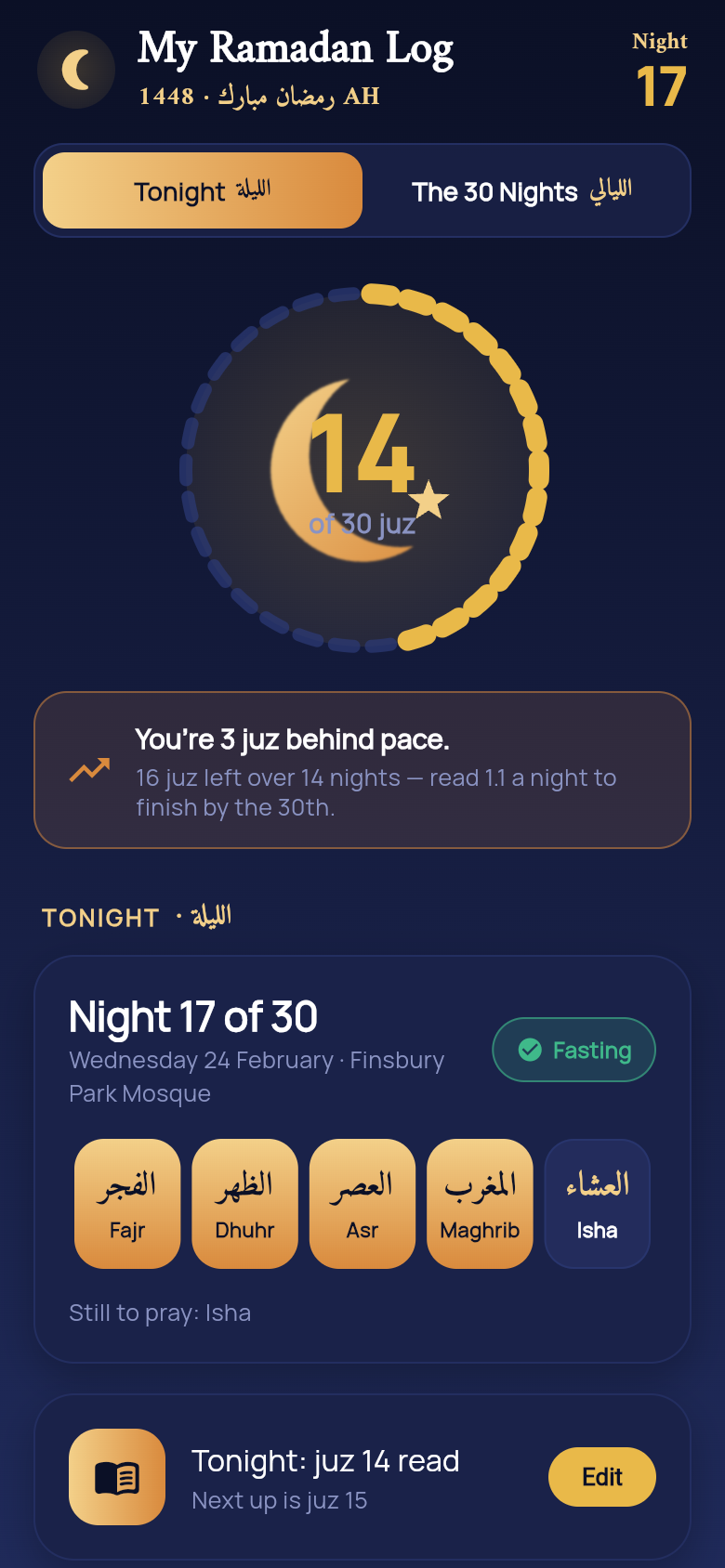
Ramadan is one month, thirty nights, and a lot to hold in your head at once. There are five daily prayers to keep, a fast to observe each day, and if you have committed to a khatm, one juz of the Qur'an to read every night so you finish the entire book by the 30th night. That is a beautiful rhythm when it works. When a late shift at work pushes Isha to 1 a.m., or an illness means you break a fast you will have to make up later, the rhythm quietly slips and you lose your place.
My Ramadan Log is a simple, offline-first app made for exactly that situation. It lives on your phone, opens instantly, and keeps an honest record of your prayers, your fasts, and your juz, night by night. Try the live version embedded in this page and see how it fits your month.
Live demo
One juz a night, thirty nights, one khatm
The Qur'an is divided into thirty roughly equal portions called juz. Read one each night of Ramadan and you finish the whole book by Eid, a practice known as completing a khatm. It sounds straightforward, and most years it is, for the first ten nights. Then the cumulative tiredness of keeping suhoor, fasting through a long working day, attending taraweeh at Finsbury Park, and still finding the focus to sit with the text, all of it adds up.
The app tracks which juz you have actually read, not which ones you planned to read. Each night you tap to mark a juz complete; the app counts how many distinct juz you have logged and shows you plainly whether you are on pace. If tonight is the 18th night and you have read fourteen juz, the tracker tells you that you need to cover sixteen more in twelve nights, which is still possible but requires doubling up some evenings. Knowing that clearly, rather than vaguely sensing you are behind, is what makes it possible to catch up.
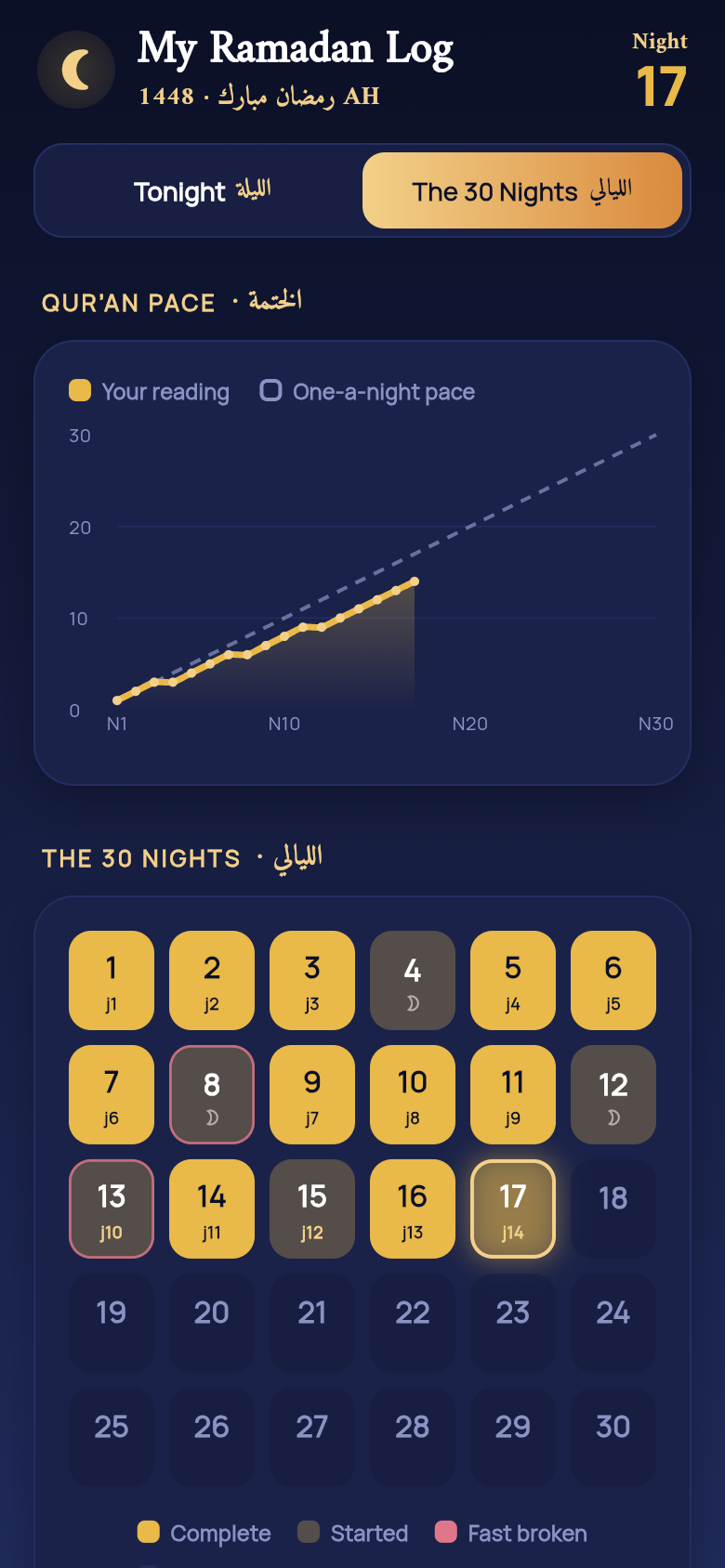
Prayers: the ones kept and the ones missed
The five daily prayers in Ramadan follow the same names and times as the rest of the year: Fajr before dawn, Dhuhr at midday, Asr in the afternoon, Maghrib at sunset, and Isha at night. Each has its moment and its window, and missing one is not a dramatic failure, just something that happens and needs to be noted honestly.
For each day the app shows a row of five ticks, one per prayer. Tap the ones you kept. Leave blank the ones you missed or still owe. There is no streak counter, no celebration animation, no judgment. The log is just a record, yours to read at the end of the month when you sit down to work out what needs making up. Taraweeh, the extra nightly prayers that many people attend at the mosque, is a bonus devotion rather than an obligatory prayer, so the app keeps the focus on the five fard prayers that carry the actual obligation.
Fasts: keeping them, breaking them, and what happens next
Fasting in Ramadan is obligatory, but Islam also recognises that illness, travel, pregnancy, and other circumstances make breaking a fast not just permissible but sometimes required. The catch is that every broken fast has to be made up after Ramadan ends, and those make-up fasts are easy to forget once the month is over and normal eating resumes.
The app gives each day a simple fast toggle: kept or not kept. If you mark a day as not kept, that day stands out in the log as one to return to. By the time Eid arrives you have an exact count, not a rough guess, of how many make-up days you owe. That is a small thing that turns out to matter quite a lot when you are trying to clear the debt before next Ramadan.
Everything works offline, from the first tap
The app was built to work without a connection. At Finsbury Park Mosque the Wi-Fi in the main prayer hall is often stretched thin across hundreds of phones; after taraweeh you might be on the bus home with no signal at all. None of that matters. Your data is stored on the device and available immediately every time you open the app.
There are no accounts to create, no passwords to remember, no syncing to wait for. You open it, you tap, you close it. The whole interaction is meant to take about thirty seconds at the end of a long night. The goal was to remove every possible reason to put it off until you have forgotten whether you prayed Fajr this morning.
Try it now in the phone frame above
The interactive demo embedded at the top of this page is the real app. You can tick prayers, mark fasts, and log juz right now to get a feel for how it works. Nothing you enter in the demo is saved permanently, so feel free to fill in a full week and see how the khatm pace indicator responds.
The most useful moment to evaluate a tracker like this is when you imagine yourself using it at 11:30 at night, tired, after taraweeh, before suhoor prep. The question is not whether the features are impressive but whether the whole thing is fast and clear enough that you will actually do it every night for thirty nights. That was the design brief, and the demo is the honest answer to whether it works.
39
files in the build
40.1 MB
app bundle
Flutter Web
runs in any browser
Build your own personal tracker
My Ramadan Log started as a one-line idea and became a working app in minutes. If you have a habit, a ritual, or a personal goal that deserves its own honest log, you can build something just like it without writing any code.