
woodworking
Ash Curing: Track Your Hurley Billets from Green to Ready
A simple tracker built for GAA hurley-makers: log your plank weights every fortnight, watch the moisture curve, and know exactly when each billet is ready to shape.
Artem
Founder
· 5 min read
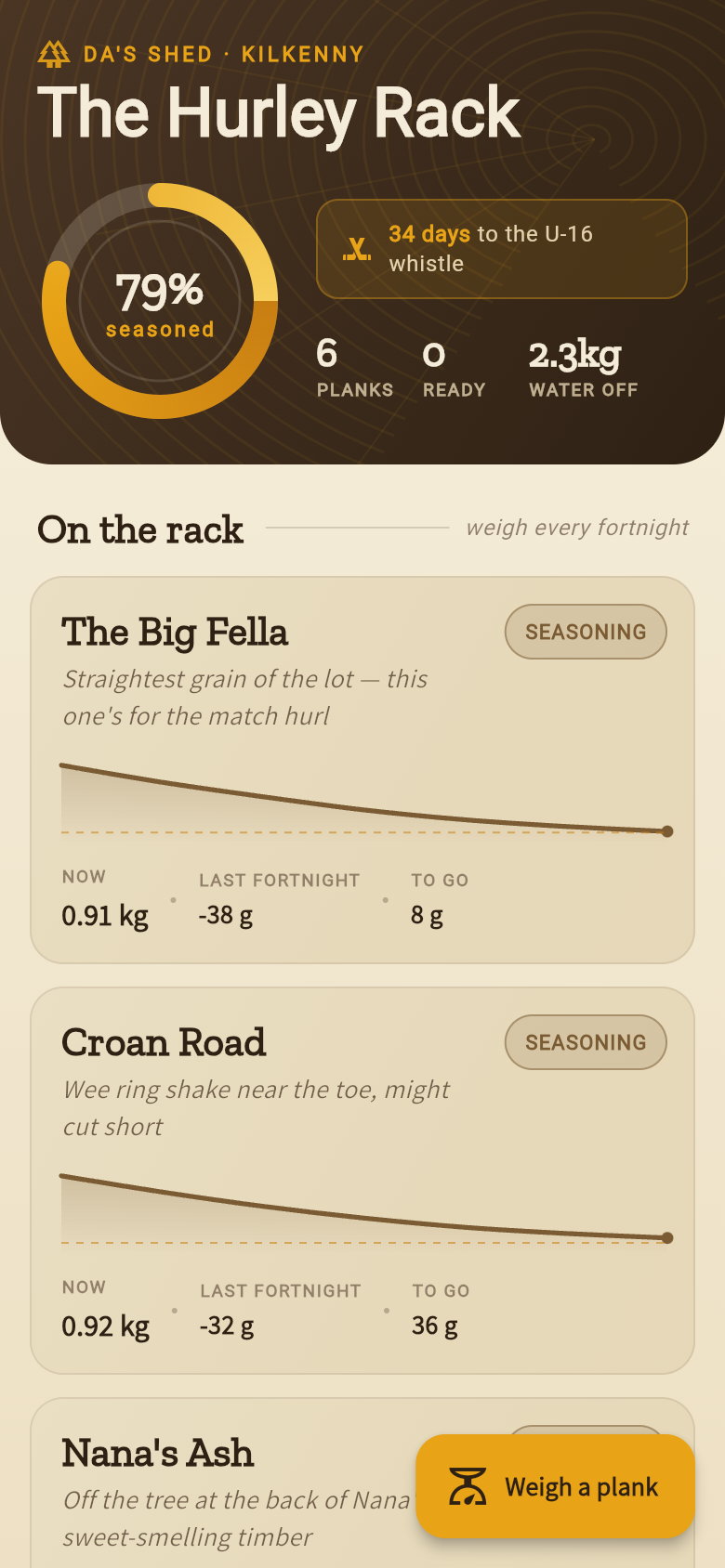
Every hurley-maker knows the frustration: you've split a good ash log into billets, stacked them in the shed, and now you wait. The wood needs to dry slowly, losing water until it's stable enough to shape without tearing the grain. Miss the window and you're rushing with wood that's still too wet. Overshoot and the season's already started. The only honest way to know where you stand is to weigh each plank on a regular cadence and watch the numbers drop.
Ash Curing is a small, focused app built for exactly this job. It keeps a running record of each billet's weight across your fortnightly weigh-ins, draws the drying curve for you, and ties everything to a season deadline so you always know how much time you have left and whether the wood is going to make it.
Live demo
The shed-wall problem
Most hobbyist hurley-makers track drying the same way: a pencil mark on the shed wall, or a notebook that gets damp, or a phone note that loses its formatting. It works until you have four or five billets on the rack at different stages, some cut earlier, some thicker, all losing water at slightly different rates.
Reading a trend from a column of scribbled numbers is harder than it sounds. You can see the latest weight, but you can't easily see whether the rate of loss is slowing down, which is the real signal that a billet is approaching its stable moisture. Ash Curing turns those numbers into a curve so the pattern is visible at a glance, not buried in a list.
The app opens full of your data, not a blank screen. Every weigh-in you've ever recorded is there, and the chart updates the moment you add a new one.
How a weigh-in works
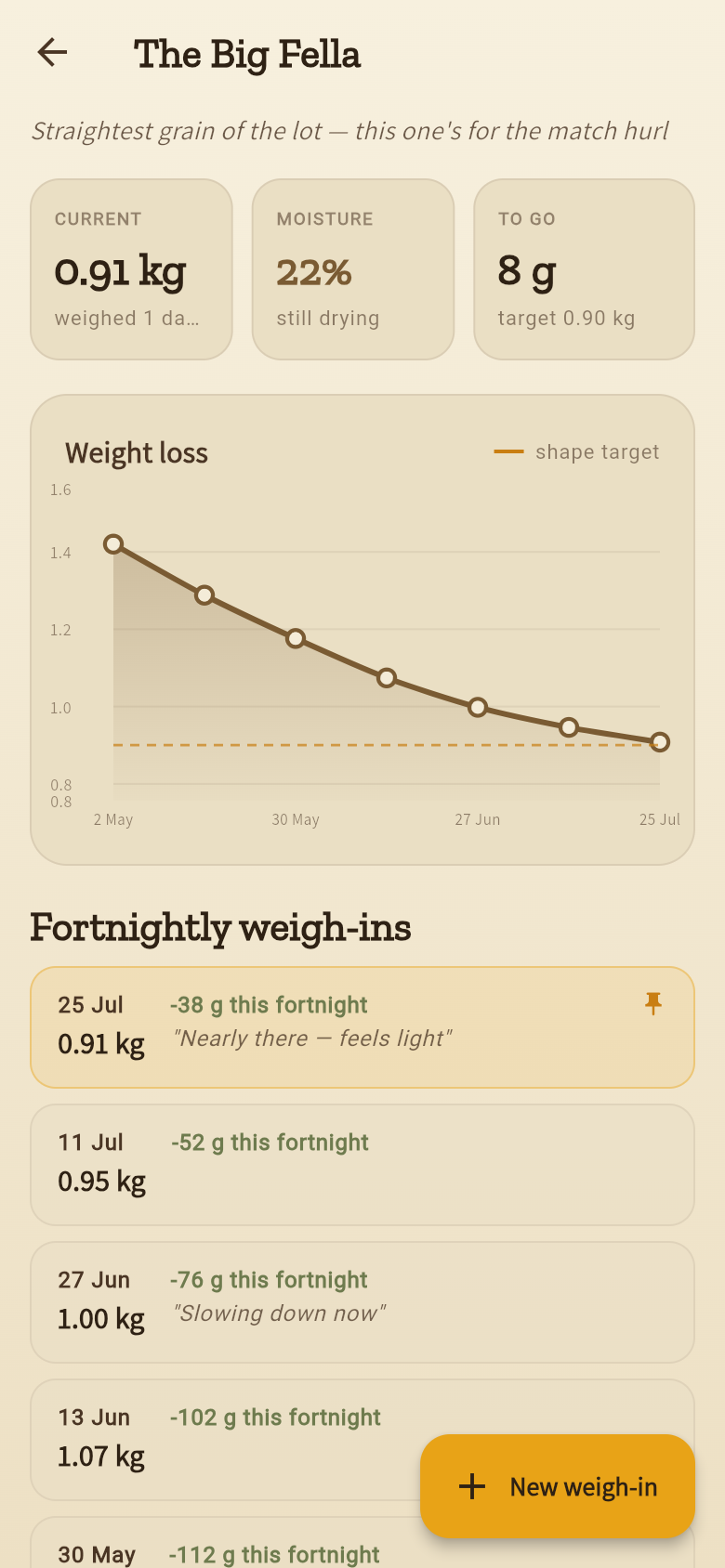
Adding a new measurement takes a couple of taps. You pick the plank, type the weight off your kitchen scales, and add an optional note if anything is worth remembering: a hairline check you spotted, or the fact that you moved the stack to a drier spot. The app records the date and shows you the loss since the last reading and the grams still to go before the billet hits your target.
Try it in the demo below. Tap a plank from the rack, hit the weigh-in button, and enter a number. The curve updates immediately and the progress figure at the top shifts to reflect the new state of the whole rack.
Everything is stored on-device. There's no account, no sync step, and it works offline, which matters when your shed is at the back of a garden with patchy signal.
Reading the curve
The weight-loss chart for each billet plots your weigh-ins as points and draws the trend against a shaping-target line. When the curve flattens and crosses that line, the billet is ready. Before that crossing, you can see roughly how many more fortnights you need, which is useful when you're working toward a fixed date like the start of a county season.
Green ash typically loses weight quickly at first, then slower as the moisture content approaches equilibrium with the air. That bend in the curve is meaningful: a billet that's still dropping fast has a different story than one whose weight has nearly stabilised. The chart makes that difference obvious without any calculation on your part.
The rack view rolls all your billets up into one overall drying-progress figure, so you don't have to check each plank individually to get a sense of where the whole batch stands relative to your deadline.
Who it's built for
The obvious user is a teenager in a county like Kilkenny or Tipperary who's seasoning their first set of billets before a GAA season, maybe with a parent who makes hurleys and wants to pass the craft on. But green-woodworkers of any kind will recognise the problem: tracking drying by weight is standard advice across spoon carving, chairmaking, and any other craft that starts with fresh-cut wood.
The fortnightly cadence is a deliberate choice. Weighing more often than that generates noise without much signal, and weighing less often makes it hard to catch a billet that's drying too fast or too unevenly. Two weeks per reading is the rhythm most experienced makers settle on, and the app is designed around that interval.
If you're working toward an external deadline, like a season start date or a competition where you want your own stick, that pressure turns a vague hobby task into something you actually need to schedule and measure. The deadline field in the app exists for exactly that reason.
Built from one idea, ready to use today
Ash Curing started as a one-line description of a real problem and was built into a working app in a single session. It ships with local persistence, a clean rack view, per-plank charts, and a deadline tracker, no bloat, no subscription, no onboarding screens to skip past.
If you have billets in the shed right now, you can start a rack, add your first weigh-in, and have a baseline in place before the next fortnight comes around. The data you put in this week will be there waiting when you pick up the scales again.
39
files in the build
40.5 MB
app bundle
Flutter Web
runs in any browser
Have a tool you wish existed?
Ash Curing came from a specific, practical problem. If you have something you track on paper, in a notebook, or in a spreadsheet that could use a proper interface, describe it in a sentence and see what gets built.