
latin
Diego Latin: Drill the Five Declensions Before Your Oral Exam
A focused study tool for seminary Latin students that tracks confidence on each noun declension, so you know exactly where to spend the last hour.
Artem
Founder
· 5 min read
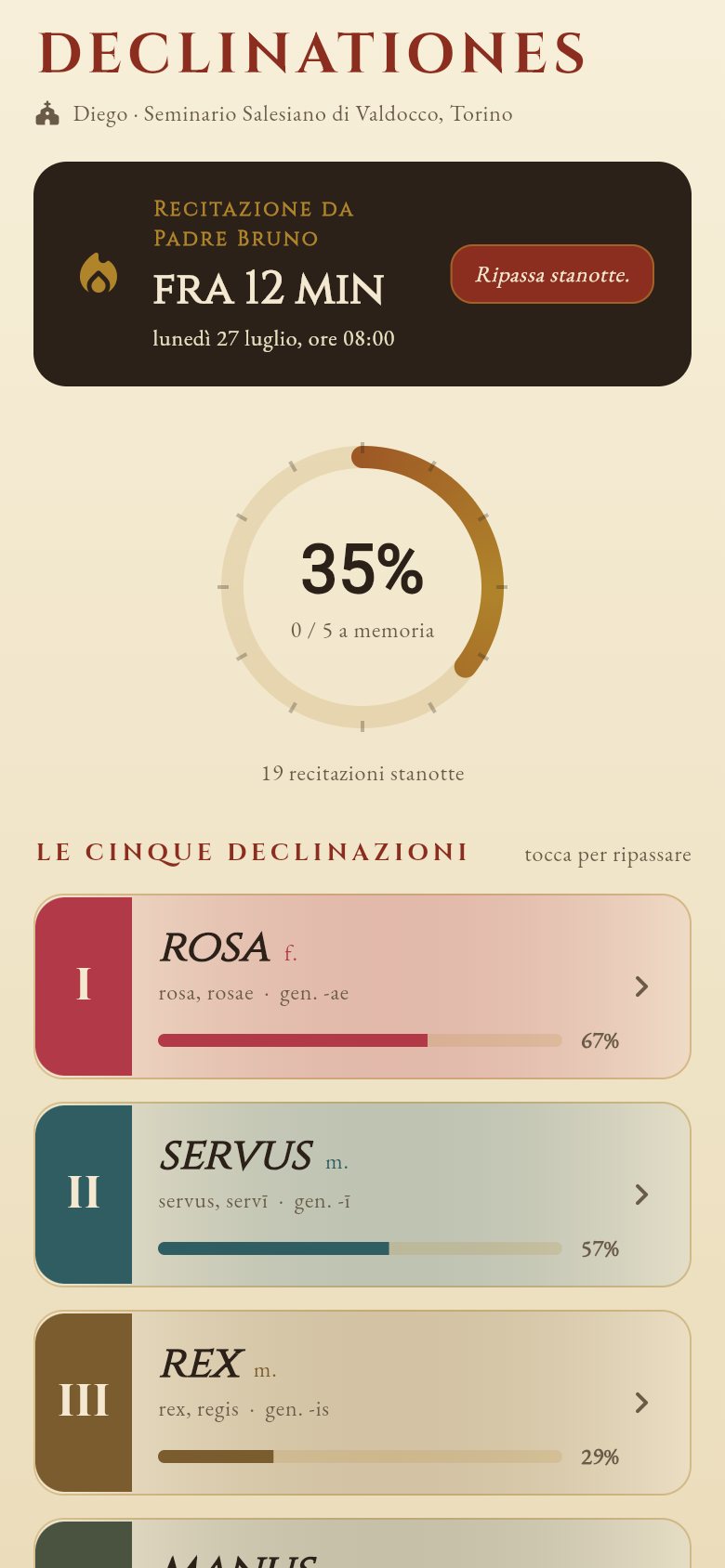
The Monday oral exam is tomorrow. Diego has five declension paradigms to recite cold, no notes, no prompts, just the examiner watching and waiting. He knows *rosa* and *servus* cold. The third declension, *rex, regis*, is shakier. The fourth is the one that keeps slipping. This is the problem Diego Latin was built to solve: not Latin in general, but this specific task, tonight.
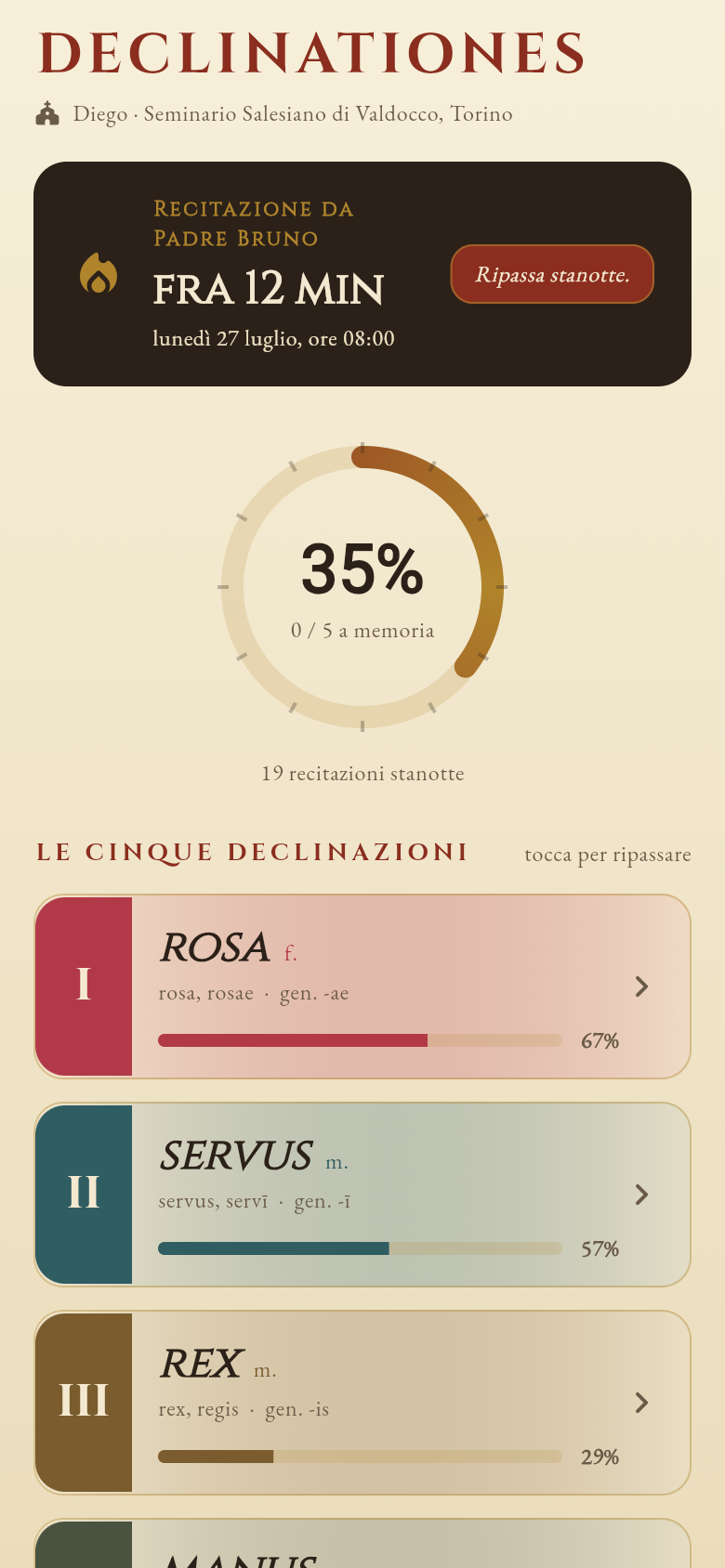
The app opens with all five paradigms already seeded with believable progress, so there is no cold-start anxiety. Diego can immediately see where he stands, mark each attempt as clean or stumbled, and watch a live countdown to the recitation. Try it in the phone frame above. Tap a declension, say the endings aloud, then record how it went.
Live demo
Why the night before is different
Most Latin resources are built for learning over weeks. They introduce cases one at a time, add grammar notes, give you exercises. That is exactly the wrong tool for the night before an oral exam. At that point you already know the material, more or less. What you need is a signal: which paradigms are solid, which are shaky, and how much time is left to fix it.
Classical Latin formation programs, including the Salesian tradition at Valdocco, still expect students to recite the five declensions from memory in the correct order: nominative through ablative, singular then plural, every ending exact. The third declension catches most students because the stem changes (*rex* becomes *reg-*). The fourth trips them up because *-us* appears in four different cases with different meanings. A flat table in a textbook shows you this, but it does not tell you that *you specifically* stumble on the fourth declension genitive plural.
What the app actually does
Diego Latin shows all five paradigms in a clean, scrollable layout, with the canonical models: *rosa* (first), *servus* (second), *rex* (third), *manus* (fourth), *res* (fifth). Each case and number is laid out the way your examiner expects to hear it. There are no quizzes, no multiple choice, no gamification. The assumption is that you are going to say the endings aloud yourself, because that is what the exam requires.
After each attempt, you mark it: clean or stumbled. The app updates a confidence indicator for that declension immediately. Over the course of an evening, a picture emerges. The first and second declensions turn green. The third stays amber. The fourth keeps getting marked stumbled. That is the one to drill for the next thirty minutes.
A live countdown sits at the top of the screen, ticking toward Monday. Alongside it is a readiness verdict, a plain honest summary of where you stand given your self-assessments. It is not encouraging if you have not earned it, and it is not harsh. It is just honest.
Built in Italian, for a student who thinks in Italian
Diego studies at the Salesian seminary in Turin. His formation language is Italian. Latin instruction at Valdocco is conducted in Italian. So the app runs in Italian: the interface labels, the verdict, the navigation, all of it. This matters more than it sounds. When you are tired and anxious the night before an oral exam, switching mental registers between your study app and your target language adds friction. Diego Latin removes that friction.
The offline-first design means it works in the dormitory, in the chapel antechamber, on the bus. No connection required, no account to log in to. Progress is saved locally, so if Diego puts his phone down and picks it up two hours later, his self-assessments are still there.
The thinking behind the confidence model
Self-assessment is a legitimate and well-studied technique in spaced-repetition learning. The key insight is that you are a better judge of your own recitation than any automated quiz can be, because you know whether you hesitated, reconstructed from a rule, or produced the ending fluently. Diego Latin leans into that. It does not check your spelling or parse your voice. It asks you one question: did that feel clean or did you stumble? Your answer updates the confidence indicator.
The model weights recent attempts more heavily than older ones, which means a paradigm you stumbled on an hour ago but have now drilled to fluency will show improvement. It also means a paradigm you marked clean early in the evening but have been avoiding since will not stay green forever. The system gently rewards consistent review, not a single lucky pass.
This is a small, focused tool. It does not try to teach Latin from scratch, explain grammar rules, or replace a textbook. It assumes you already have the knowledge and need help turning it into reliable recall under pressure. That narrow focus is deliberate.
What it feels like to use it
Open the app and the first thing you see is your readiness summary and the countdown. It is a little confronting, but honestly so. Scroll down and you see all five paradigms laid out, each with its confidence badge. The ones you have not touched yet show a neutral state. Tap the first declension. *Rosa, rosae, rosae, rosam, rosa, rosa. Rosae, rosarum, rosis, rosas, rosae, rosis.* Mark it clean. The badge updates. Move to the second.
By the third or fourth pass through all five, the pattern becomes clear: the first two are solid, the third is improving, the fourth needs another circuit. The countdown is not scary anymore because you know what you are doing with the remaining time. That is the whole point. Not to eliminate the anxiety of an oral exam, but to replace vague dread with a specific, actionable picture of where you actually stand.
39
files in the build
40.8 MB
app bundle
Flutter Web
runs in any browser
Have a tool you need before tomorrow?
Diego Latin went from a one-line idea to a working app in minutes. If you have a specific problem you need to solve, describe it and build your own.