
mental health
Name It: Find the Exact Word for How You Feel
A tap-through emotion wheel that takes you from 'stressed' to 'apprehensive' or 'overwhelmed' in seconds, with a private journal and honest patterns over time.
Artem
Founder
· 5 min read
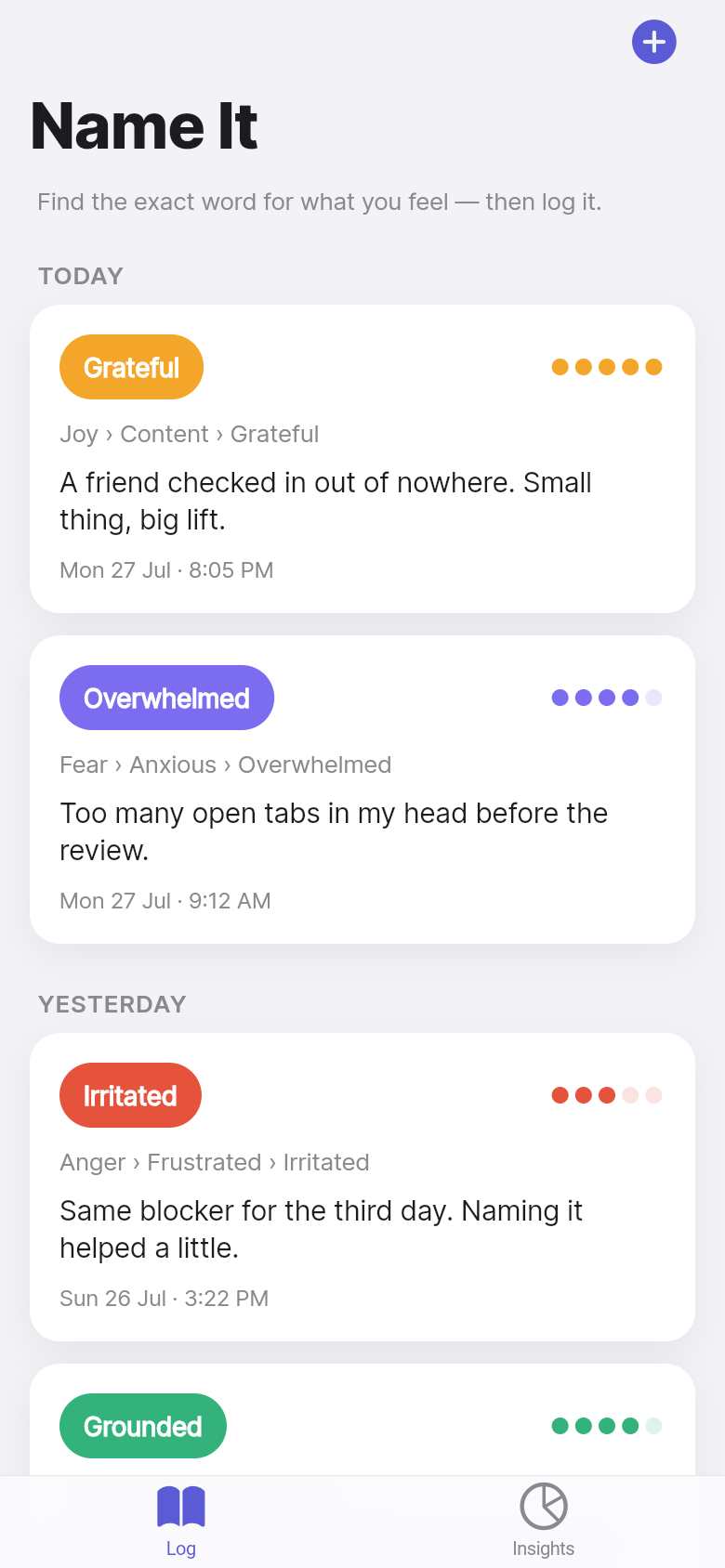
Most of us have a small working vocabulary for feelings. Something happens, and we reach for 'fine', 'stressed', or 'off' because those words are right there. They are not wrong, exactly, but they are blurry, and blurry feelings are harder to act on, harder to talk about, and harder to let go of. Psychologists call the ability to put precise names on emotional states 'emotional granularity', and research consistently links it to better regulation, fewer sick days, and lower reactivity. The problem is not motivation. It is that in the moment, nobody wants to consult a vocabulary list.
Name It is a small, private app built around one idea: you should be able to move from a vague sense to an exact word in two or three taps, without knowing the word in advance. Go ahead and try it in the phone frame on this page. Pick the feeling that is closest to where you are right now.
Live demo
The wheel, not the search box
The emotion wheel starts wide: Joy, Sadness, Anger, Fear, Disgust, Surprise. You do not need to know where you are going. You tap the family that feels roughly right, and the wheel opens inward to more specific words. Tap again, and you reach something like 'apprehensive', 'resentful', 'wistful', or 'elated'. Two or three taps from blank to precise.
This matters because the way you search for a word and the way you recognize one are very different cognitive tasks. Searching is hard when you are in an emotional state. Recognition is much easier. The wheel is designed for recognition: you see options, something clicks, you tap it. No typing, no scrolling through alphabetical lists, no knowing the answer before you start.
Log it and move on
Once you have named the feeling, the app lets you mark intensity on a simple scale and add a short note if you want one. Most of the time you will not. The point is not to process the feeling right there; it is to name it and let your nervous system register that the signal was received. The log entry takes under a minute.
Everything stays on your device. There is no account, no sync, no server. Your journal is yours, readable only by you, and it stays there until you delete it. For people who are already cautious about which apps they trust with sensitive data, this is not a minor detail. It is the whole reason they will actually use it.
Patterns that make logging feel worthwhile
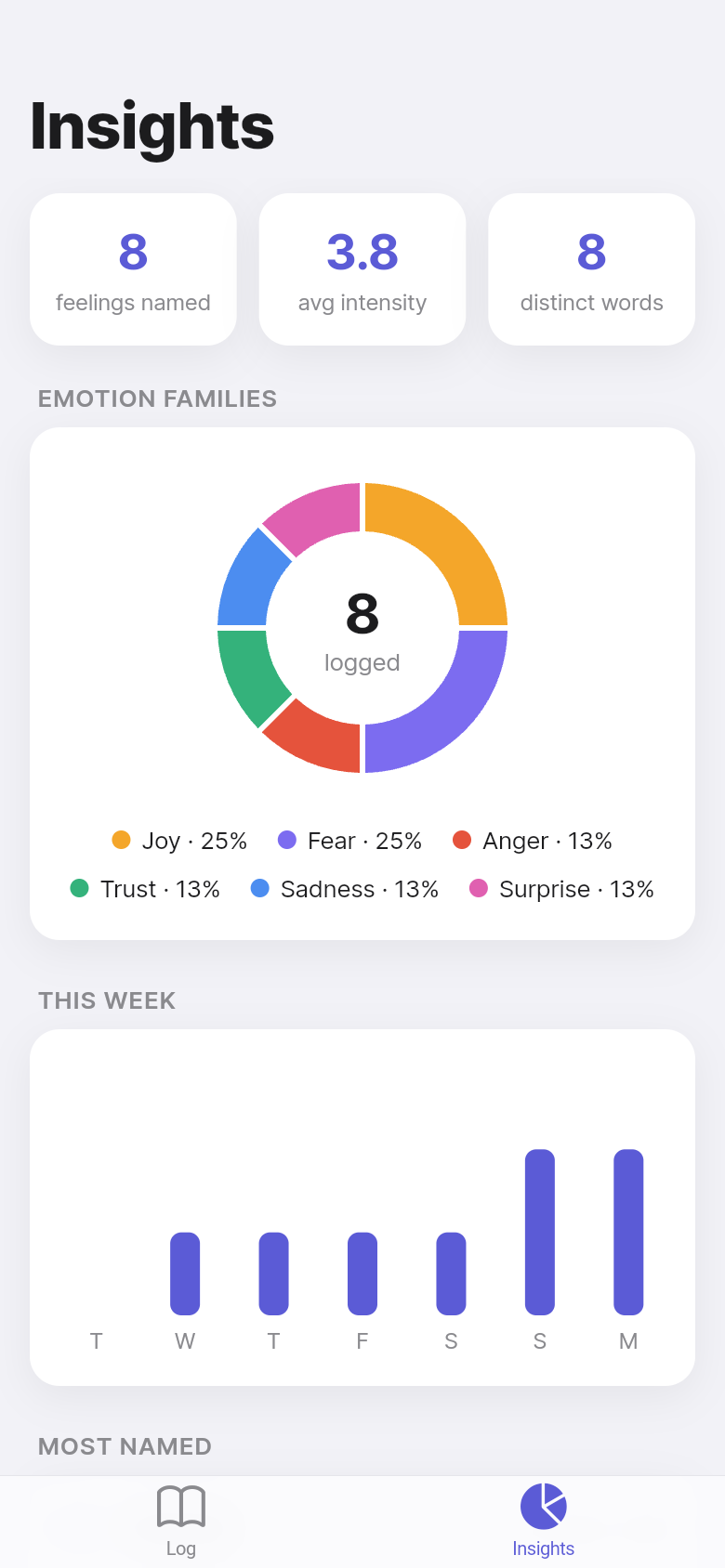
A journal you never look back at starts to feel like a chore. Name It shows you simple patterns over the entries you have already logged: which emotion families show up most often, how frequently you check in, and how many distinct words you have used across all your entries. That last one is quietly motivating. Watching your feeling vocabulary grow week by week is a concrete sign that something is shifting in how you pay attention.
The app also opens with a small set of believable sample entries so the first time you open it, the value is visible immediately. You can see what a journal looks like with real data before you have contributed any of your own. That matters because the hardest log entry is always the first one.
Who this is actually for
Therapy clients often leave sessions with a vague instruction to 'notice how you feel this week'. Between appointments, the noticing tends to collapse back into 'fine'. Name It gives that noticing somewhere to land, with enough precision to bring something real back to the next session.
It also fits naturally alongside journaling, mindfulness practice, or CBT exercises, not because it replaces any of them, but because it does one thing those practices often skip: the moment of naming. Journalers can use it before they open their notebook. Meditators can use it right after sitting. Anyone building a check-in habit can use it instead of a 1-to-5 slider that never tells them anything new.
The emotion wheel as a concept has been shared by therapists, pinned millions of times on Pinterest, and cited in popular psychology for years. Name It is what happens when that graphic becomes something you can actually use on your phone, every day, in under a minute.
Built from a single idea, fast
This app started as a one-line description of a problem: people need a faster, lower-friction path from a fuzzy feeling to an exact word. From that, Leanfinit generated a working app, complete with the wheel interaction, the journal, the patterns view, and offline-first storage. The result is not a prototype. It runs in the frame on this page right now.
The point is not that the app was built quickly, though it was. The point is that ideas like this, ideas that solve one specific human problem well, deserve to exist. They do not need a year of development and a funding round. They need a clear problem, a clean interaction, and the right tool.
39
files in the build
40.1 MB
app bundle
Flutter Web
runs in any browser
Have a small app idea of your own?
If you have been sitting on an idea for a tool that solves one real problem, you can describe it in a sentence and see a working version. No code, no team, no waiting.