
health
Mum's Hip: A Recovery Tracker Built for Family Carers
When your mum comes home after a hip replacement, the surgeon says 'watch her progress.' This app gives you somewhere to actually put it.
Artem
Founder
· 4 min read
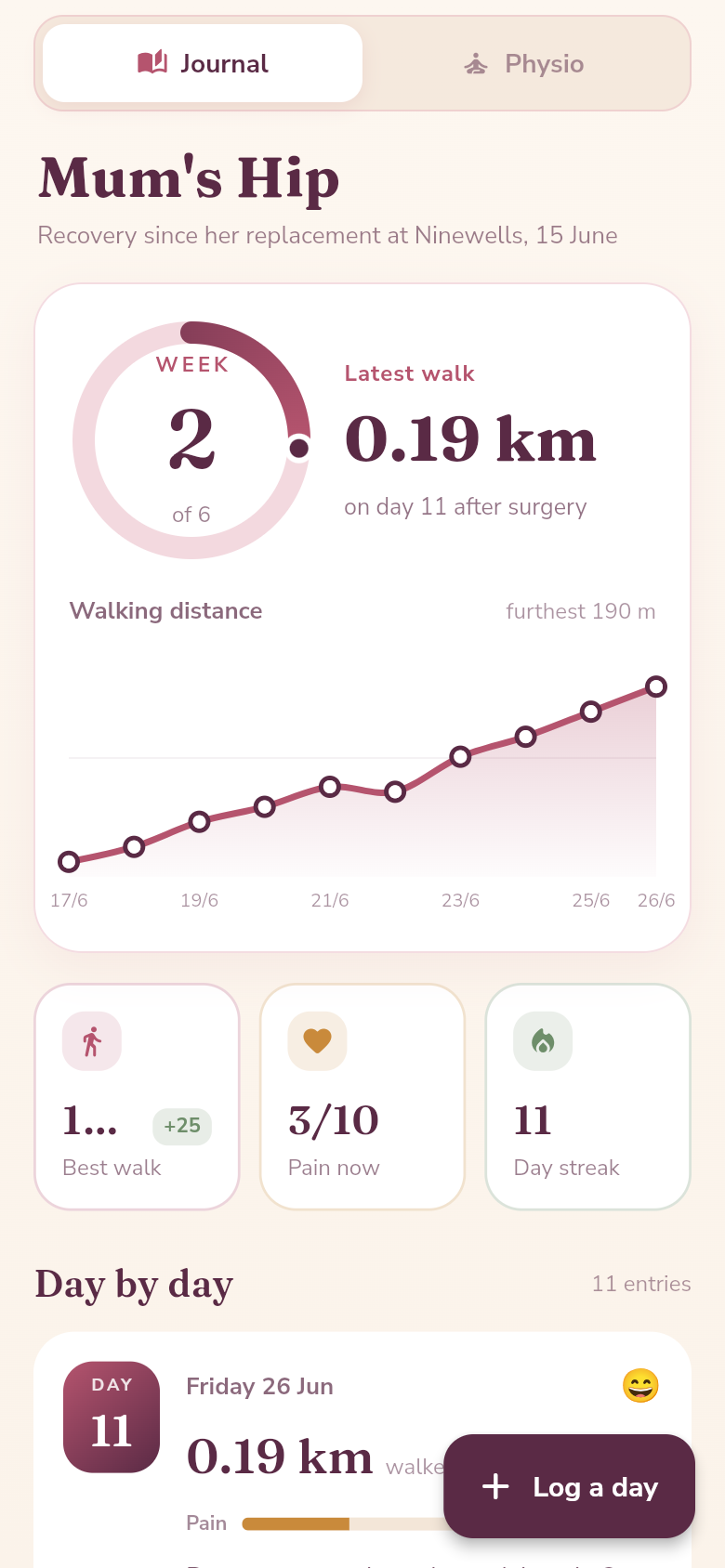
The surgeon shakes your hand, says 'watch her progress week by week,' and hands you a photocopied physio sheet. That's it. You're the carer now, and the tools you've been given are a piece of paper and good intentions. Within three days, the notes are on the back of an envelope, the envelope is under a mug, and you can't remember whether Monday's walk was a hundred metres or two hundred.
Mum's Hip is a small, focused app built exactly for this window, the few weeks when an elderly parent recovers at home after hip or knee replacement surgery. It lives on your phone, works without any account or internet, and opens already full of sample data so you can see at a glance what it's meant to do. Try it in the frame below.
Live demo
One entry a day, no more
Each day you log four things: how far she walked, a pain score from 0 to 10, how her spirits seemed, and which physio exercises she actually did. That's the whole form. It defaults to the next day after your last entry, so you're not hunting for a date picker, you just fill in what happened and tap save.
The design is deliberately simple because you're doing this at the end of a day that was already tiring. There's no elaborate tagging system, no text notes field that becomes a diary you then have to read back. Numbers and checkboxes, done in under a minute.
See the trend, not just the number
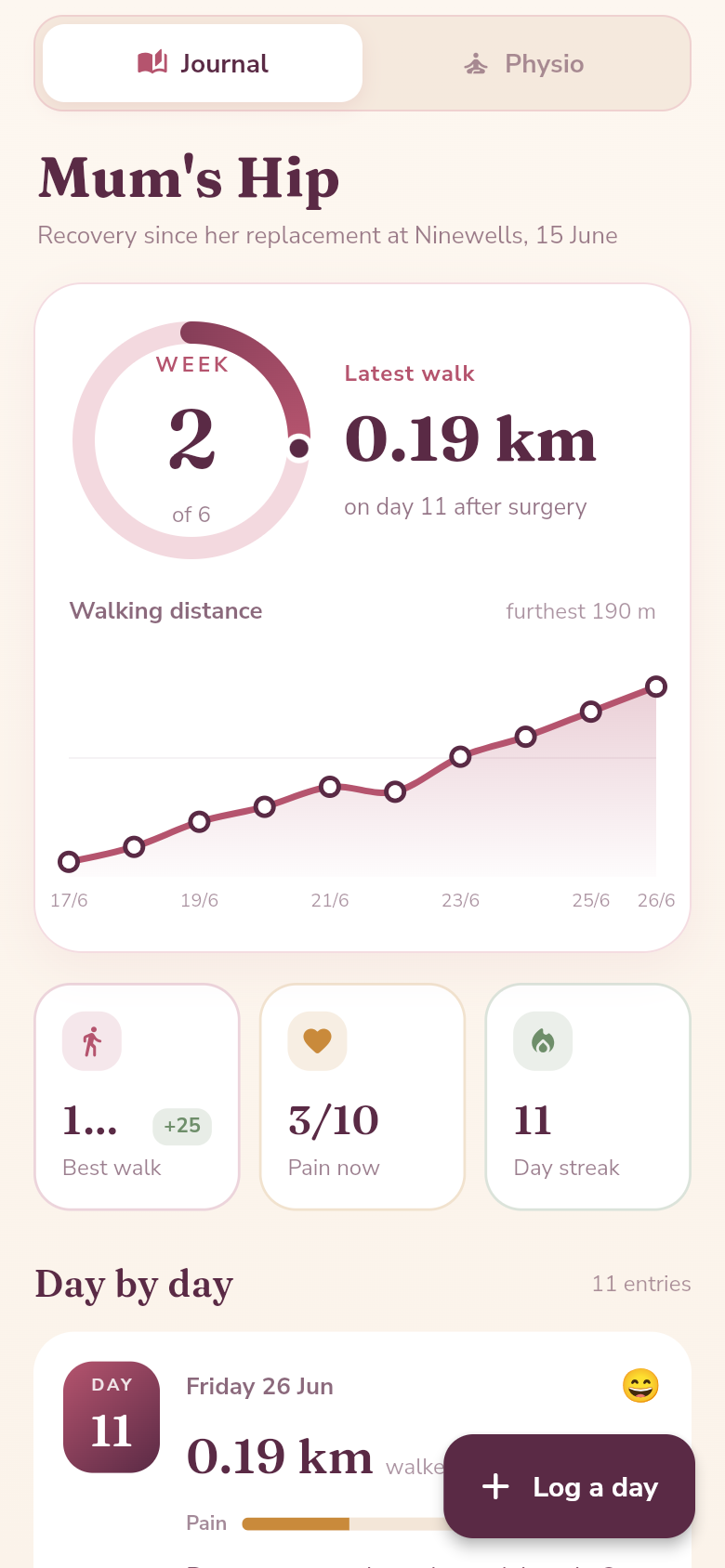
The dashboard shows three things that matter: a walking-distance chart across all your entries, a summary of her best walk, lowest recent pain score, and current daily streak, and a recovery-week ring that shows where she is in the six-week programme. You're not looking at today in isolation. You're looking at whether the line is going up.
This is what makes it genuinely useful at the surgeon's follow-up. Instead of saying 'I think she's doing better,' you can open the chart and say 'she walked forty metres in week one and two hundred and twenty in week three.' That's a different kind of conversation.
Tap through the live app in the frame to see how the chart and stats update as you add or edit entries. The sample data loads on first launch precisely so the trend view is immediately readable, not an empty screen.
The physio sheet, built in
Most discharge physio programmes follow the same arc: ankle pumps and heel slides in the first days, progressing to standing hip exercises and short walks by week two or three. The app includes that programme as a reference, with a per-exercise count of how many days it's been completed.
It doesn't nag or send reminders. Rehab at this stage is hard and the parent sets the pace. But having the exercise list inside the same app as the progress log means you're not switching between a crumpled sheet and a phone. Everything is in one place, and the 'days done' count is a gentle, honest record of how consistently the programme is being followed.
Offline, private, no account
Health data about a family member is personal. Mum's Hip stores everything on the device, requires no sign-in, and doesn't send anything anywhere. There's nothing to configure before you can start using it.
That also means it works in a house with poor wifi, in a hospital waiting room on mobile data, or handed to the patient herself to show the physiotherapist. The data is just there, in the app, whenever you need it.
It was built from a single idea in a short afternoon, which is part of the point. The problem, a family carer with no good tool for a defined six-week job, was specific and real. The solution didn't need to be complicated, it needed to be exactly right for that situation.
How the six weeks actually feel
Week one is cautious. Pain scores are high, walks are short, and you're not sure if what you're seeing is normal. Week three, if things are going well, the chart starts to climb and the pain line starts to fall. By week five or six you're preparing for the follow-up and you want to be able to say something concrete.
Having a running log doesn't change the recovery. But it changes how you feel about it. You can see that Tuesday's bad pain score was a blip, not a trend. You can see that the walking distance has more than doubled since discharge. That kind of visibility is reassuring in a way that memory and scattered notes simply aren't.
If you're caring for a parent right now, scroll back up and spend a couple of minutes with the live demo. Log a day, look at the chart, find the physio list. The whole shape of the thing becomes clear very quickly.
39
files in the build
40.6 MB
app bundle
Flutter Web
runs in any browser
Have a problem that deserves its own tool?
Mum's Hip started as a one-line description of a real situation. If you have a task that paper and generic apps aren't quite handling, you can build something specific to your situation in the same way.