
productivity
Chore Wheel: Fair Rotation for Shared Households
Stop arguing about whose turn it is. Chore Wheel auto-rotates cleaning duties so every flatmate pulls equal weight, week after week, without a single reminder.
Artem
Founder
· 4 min read
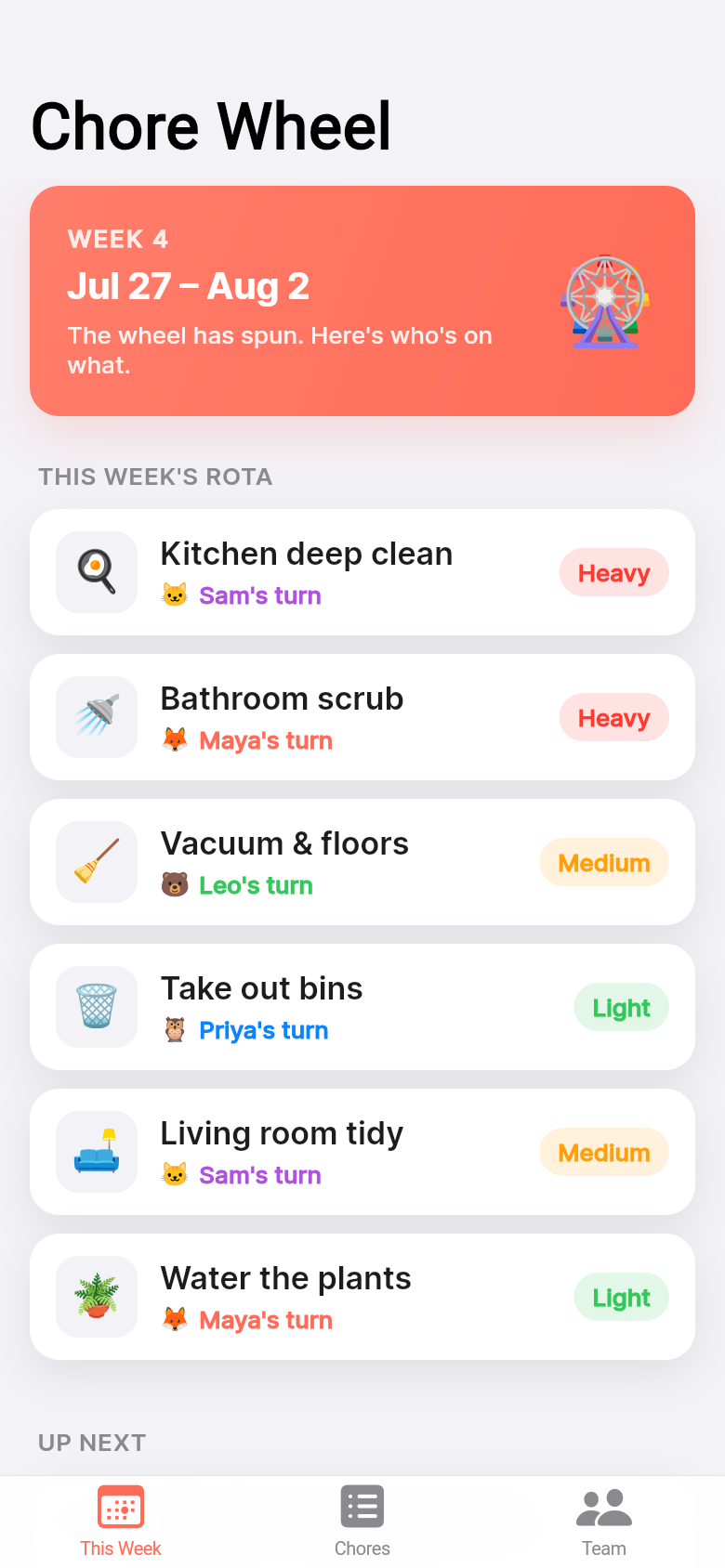
Every shared household has one: the person who quietly scrubs the bathroom while everyone else is mysteriously busy. It's not that their flatmates are lazy, it's that 'whose turn' lives in someone's head, on a fridge note nobody looks at, or in a group chat thread that scrolled away three weeks ago. The system breaks down, resentment builds, and the same argument starts again on Sunday morning.
Chore Wheel is a small app built to solve exactly that friction. It keeps a rotating schedule for every recurring chore in your home, shows each person what they're on this week, and makes the load visible so the question of fairness answers itself. Try it in the demo below, then read on to see how it works.
Live demo
The problem with informal systems
Whiteboards, spreadsheets, and group-chat reminders all share the same flaw: they depend on someone remembering to update them. That someone is almost always the most conscientious person in the house, which means they're already doing the most work before the cleaning even starts.
Perceived unfairness is one of the most consistent friction points cited in shared-living forums and roommate advice communities. It rarely comes down to one dramatic incident. It accumulates, slowly, from a dozen small moments of 'I did it last time' that nobody else tracked.
A rotating schedule fixes this at the root. When turns are decided automatically, there's nothing to argue about and nothing to forget to update. The system is the referee.
How the rotation works
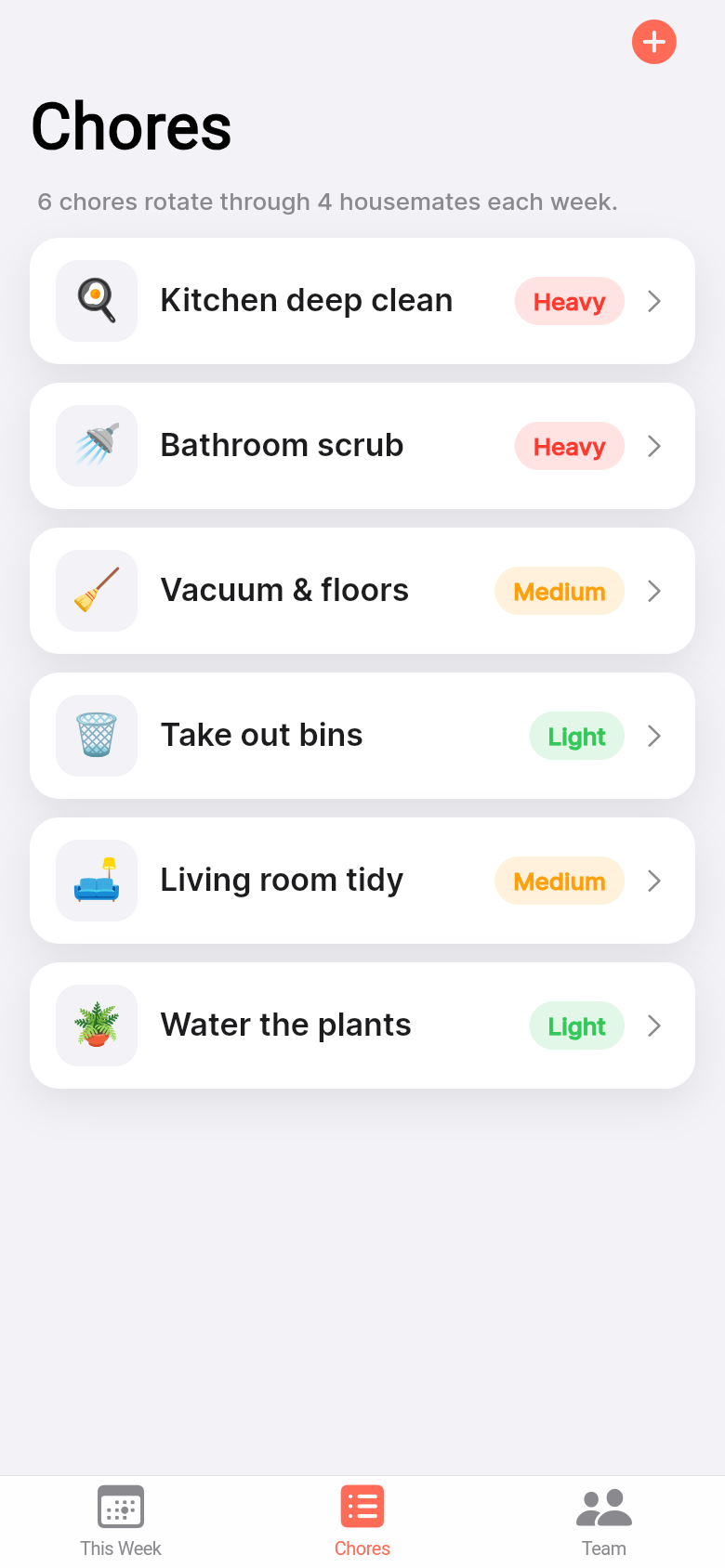
Open Chore Wheel and you'll see each chore in the house paired with the person responsible for it this week. The app comes loaded with believable sample data so you're never staring at an empty screen wondering what to add first. Edit the list to match your actual home, add everyone who lives there, and the rotation configures itself.
Each chore automatically moves to the next person at the start of a new week. You can also see a preview of next week's assignments, which turns out to be genuinely useful: if you know you'll be away Thursday through Sunday, you can swap with a flatmate in advance rather than leaving a gap.
Chores can be weighted by effort. Cleaning the bathroom is not the same job as taking out the recycling. Weighting lets you balance the schedule so one person isn't always holding the heavy end of the rota even if they're technically rotating fairly by count.
Making fairness visible
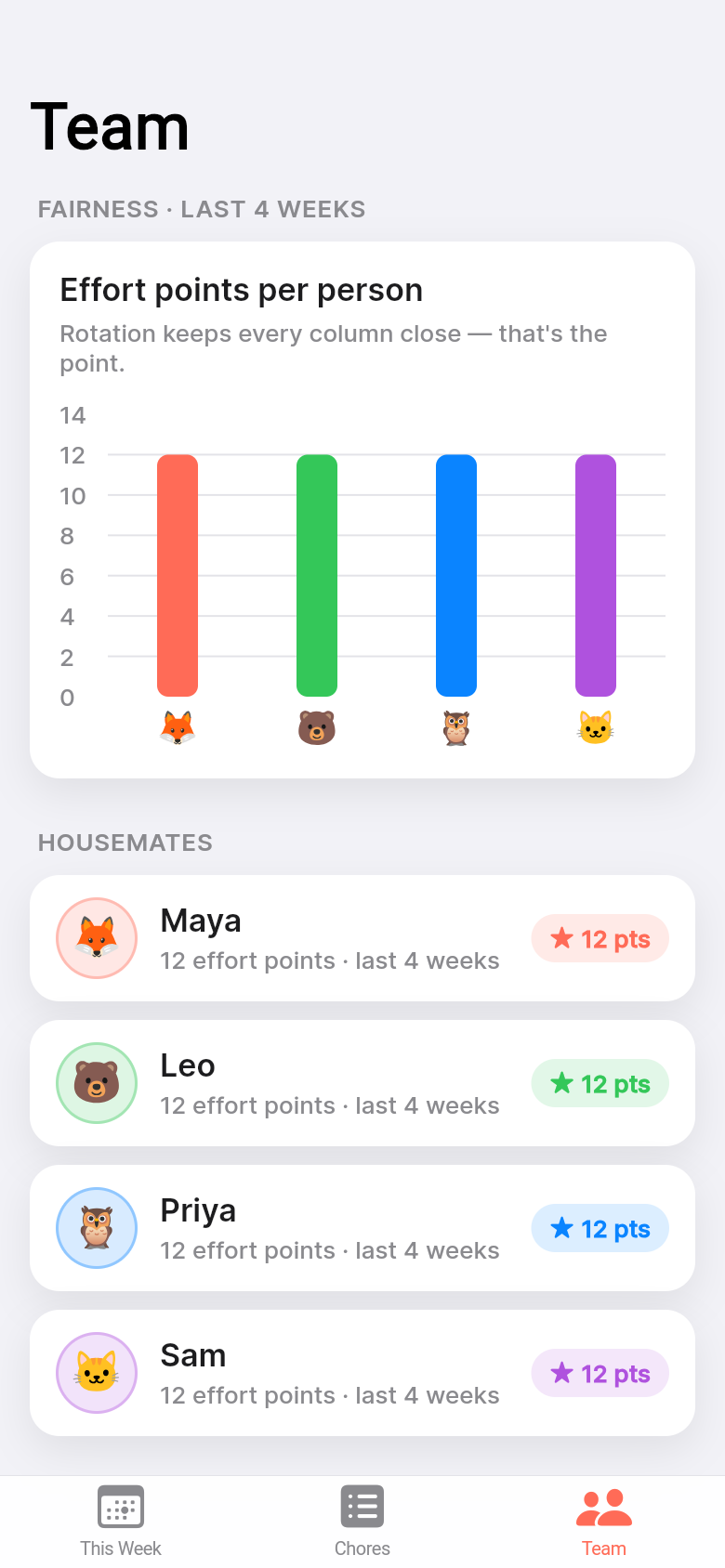
The fairness view is the part of the app that quietly does the most work. Over time it shows each person's cumulative load, so if someone genuinely has been picking up more than their share, that's visible to everyone, not just to them.
This changes the dynamic of the conversation. Instead of 'I always do the bathroom', which sounds like an accusation even when it's true, the app shows a chart that either confirms it or defuses it. Disagreements about fairness tend to dissolve when the data is right there on everyone's screen.
Give the live demo a tap. Add a chore, adjust the weight, and watch how the rotation updates. The interface is designed to take about thirty seconds to understand, because a chore-tracking app that requires onboarding has already lost.
Who this works for
Student houses with three or four people are the obvious fit. But the same problem shows up in couples who've discovered that 'we'll just take turns' doesn't survive contact with a busy week, and in families where kids are old enough to have assigned duties but young enough to need a visible, fair system to buy into.
Because Chore Wheel works fully offline, it doesn't need everyone to have the same app installed or to be signed into the same account. The person who set it up can show it on their phone during Sunday dinner and everyone can see their assignments for the week. Low friction was a deliberate choice.
The app doesn't send push notifications, it doesn't nag, and it doesn't require a login. It just holds the schedule and shows you what's true. That turns out to be enough.
Built from a single idea
Chore Wheel started as a one-line description of a problem: shared households constantly re-argue whose turn it is because chore duty lives in someone's head. From that sentence, a working app with rotation logic, effort weighting, and a fairness view was built in one session.
If your household has a different flavor of the same problem, or if you have a completely unrelated tool you've been meaning to build, the same process is one prompt away.
39
files in the build
40.1 MB
app bundle
Flutter Web
runs in any browser
Have an idea for a tool your household actually needs?
Describe the problem in a sentence and Leanfinit builds you a working app, live and interactive, in minutes. No coding, no setup, no waiting.