
fitness
Soreness Map: Know Which Muscles Are Ready to Train
A simple body heatmap that turns how you feel into a training decision — tap your sore spots, see what to train today, no wearable required.
Artem
Founder
· 4 min read
You squatted hard on Tuesday. Now it's Thursday and your legs still feel heavy. Do you train them again or give it another day? Most lifters answer that question with a gut check — which is fine, until the gut check is wrong three weeks in a row and your knees start complaining. Soreness Map is a small tool that turns that fuzzy feeling into something you can actually see.
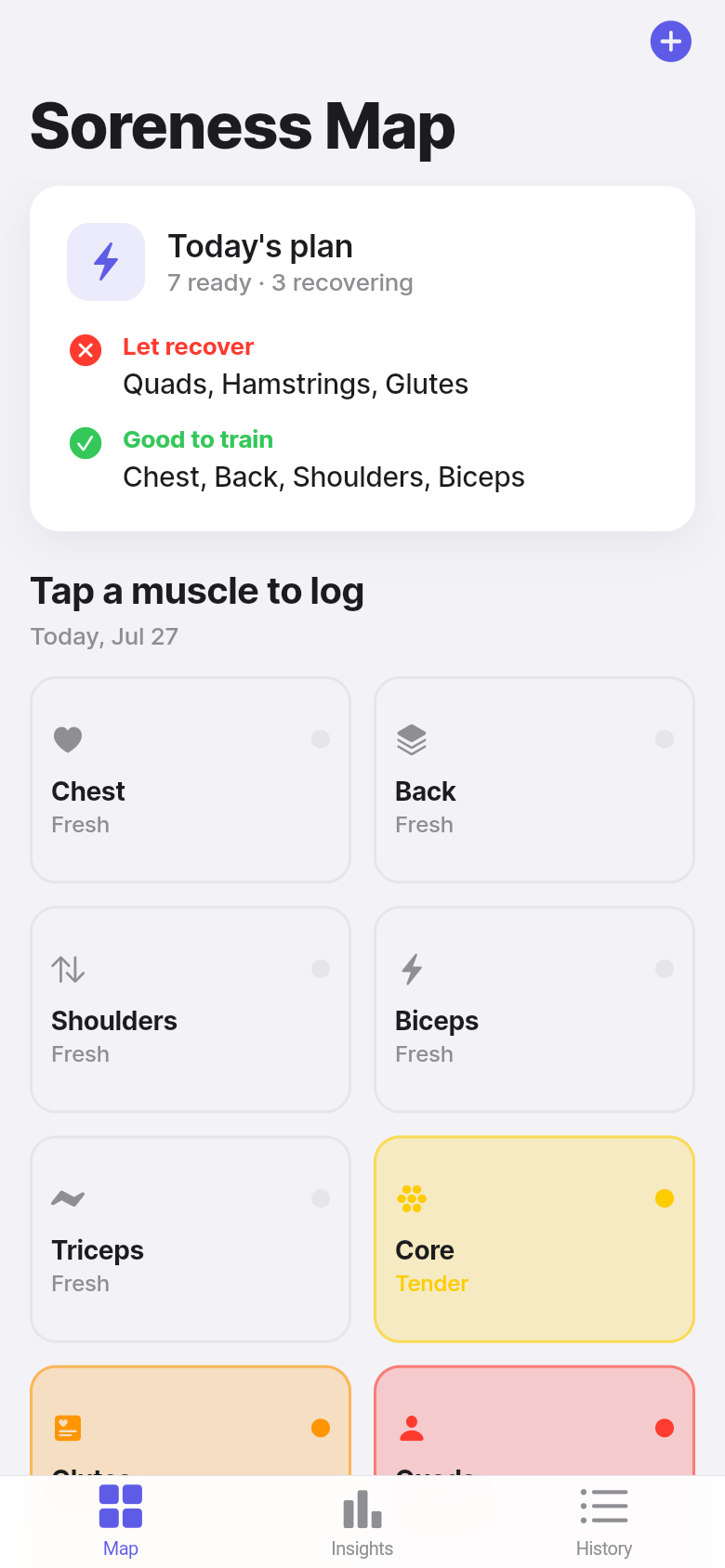
Tap the app below and try it yourself. Tap a muscle group, rate how it feels right now, and watch the heatmap update in real time. The whole thing takes about fifteen seconds — and after a week of honest check-ins, you have a recovery picture that tells you a lot more than a sore quad ever could on its own.
Live demo
The Problem With Training by Feel
Delayed-onset muscle soreness peaks around 24 to 48 hours after training, which means what your legs feel like on Wednesday reflects Tuesday's workout, not Monday's. That delay makes it genuinely hard to connect effort to recovery without writing things down. Most people don't write things down.
The result is a familiar pattern: you hammer chest twice because you feel fresh on Monday and Wednesday, you skip back because it always feels a little tight, and three months in you notice your pull days have quietly disappeared. Or you do the opposite and train legs every single day because "it feels fine" right up until the point it doesn't. Soreness Map exists to break that cycle with the smallest possible intervention — a thirty-second log at the start of each session.
How the Heatmap Works
The interface is a front-and-back body diagram. Tap any region — quads, upper back, shoulders, hamstrings — and a simple slider lets you rate soreness from none to severe. That's the whole input. There's no heart rate, no sleep data, no subscription asking for your credit card.
What you get back is a color-coded heatmap: cooler colors for muscles that are fresh and ready, warmer colors for the ones that need time. At a glance, before you've even changed into your gym clothes, you can see whether today is a push day, a pull day, or a day to just walk and stretch. The app doesn't tell you what to do — it shows you what your body already knows and lets you decide.
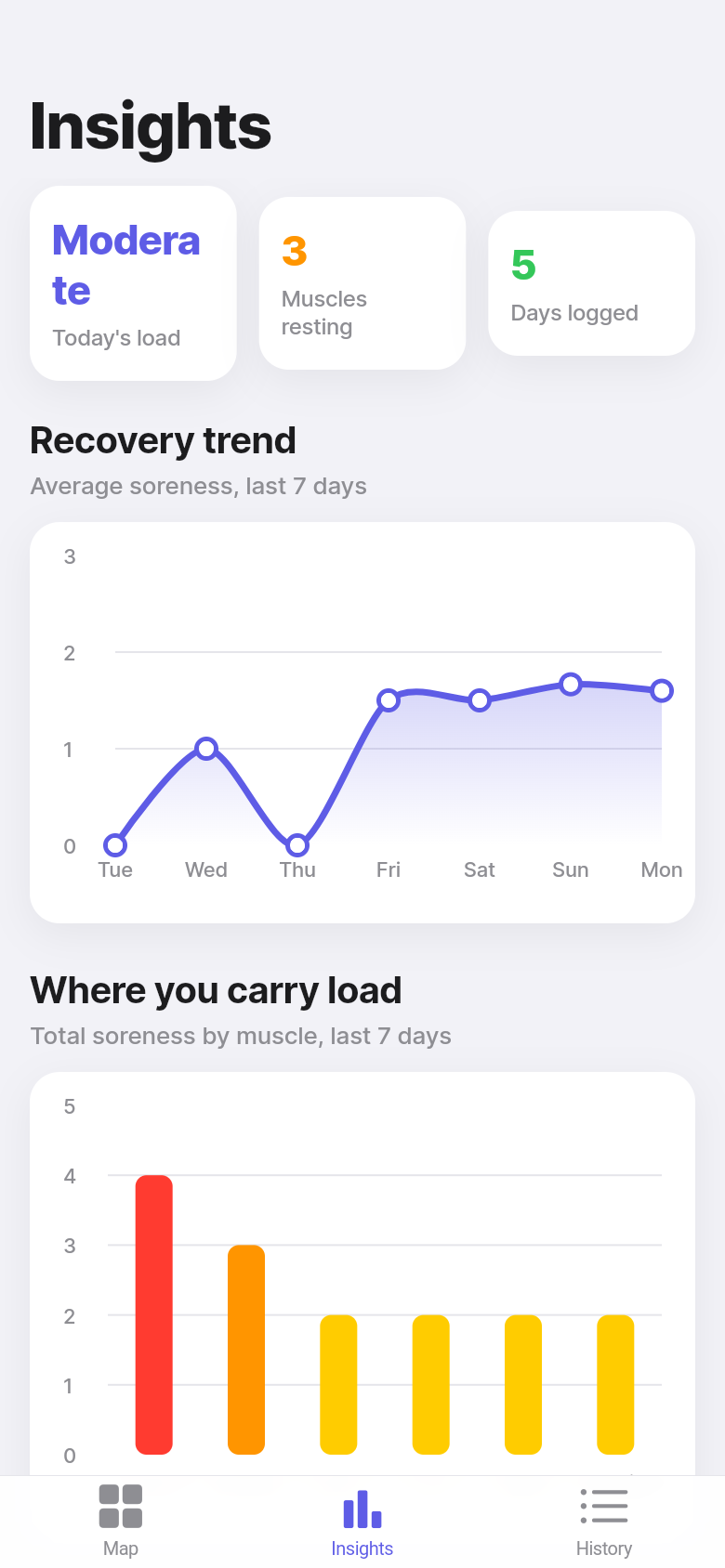
The recovery trend view is where it gets more useful over time. Chronic soreness in a specific area — say, your lower back always showing up orange on the map — is a signal worth paying attention to. It might mean your form needs a check, your volume is too high, or you're just not sleeping enough. The map doesn't diagnose anything, but it makes the pattern visible so you can act on it.
Built for Lifters Who Don't Want Another App
Most recovery tracking lives inside platforms built around wearables. You need an Oura ring, a Garmin, a Whoop strap. The data is good, but the barrier is real — both in cost and in the mental overhead of maintaining another ecosystem. Soreness Map skips all of that. It works offline, keeps everything on your device, and asks for nothing more than a tap.
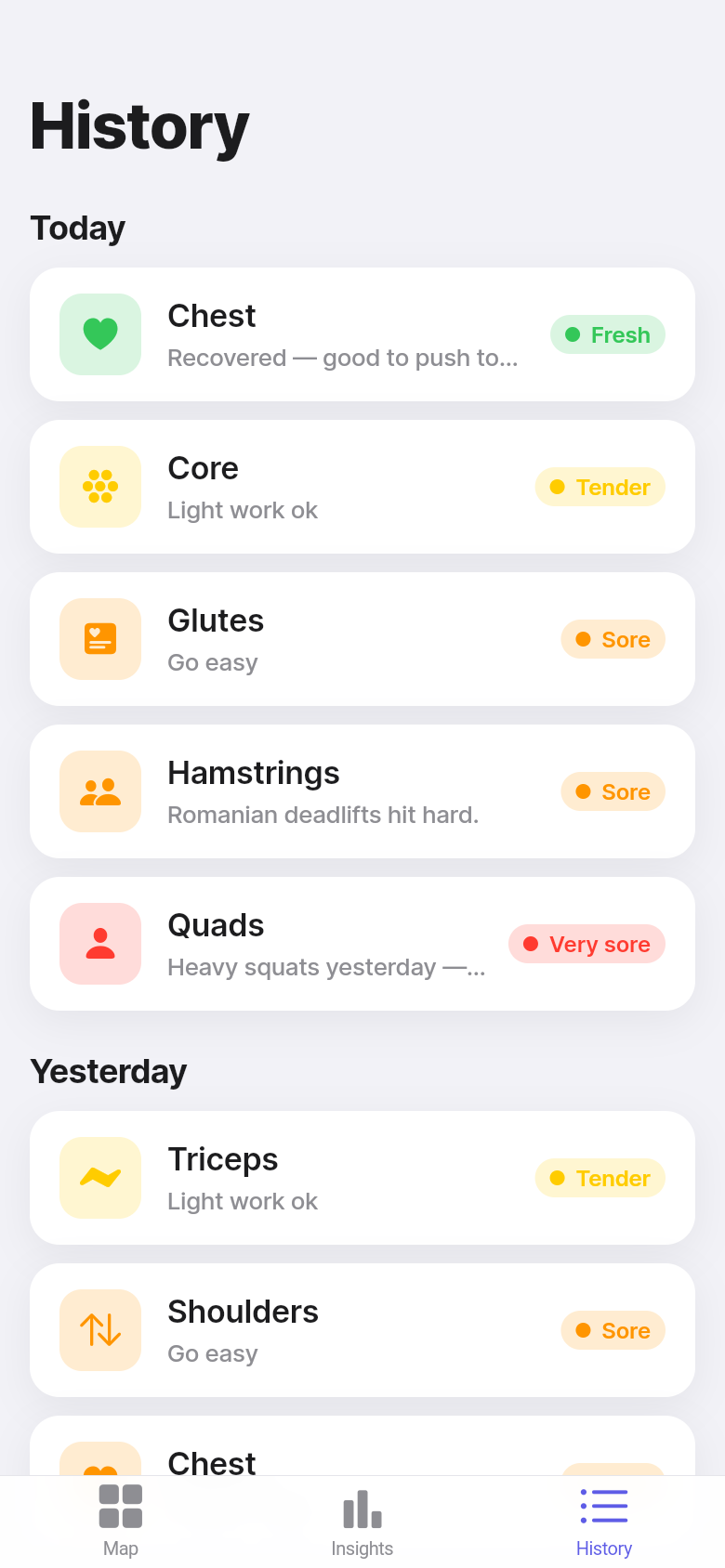
The intended user is someone on a push/pull/legs split, or any body-part program, who wants to auto-regulate without hiring a coach. Intermediate lifters often know enough to train hard but haven't yet developed the instincts to know when not to. This app fills that gap without pretending to be something it isn't. It's a log, a heatmap, and a short memory — nothing more, nothing less.
If you're training five or six days a week and you've ever Googled "should I train legs if they're still sore," this is the tool that question was asking for.
Try It Now, Then Build Your Own
The live demo embedded above is a fully working copy of the app. Tap a few muscle groups, set a soreness level, and see the heatmap respond. Then come back after your next session and log again. Two or three check-ins is enough to see how it reads your personal recovery rhythm.
Soreness Map started as a one-line idea — a body map that shows what's recovered and what isn't — and turned into a working app in a single afternoon. If you have a tool like this that you've been wishing existed for your own training, your morning routine, or anything else you track by habit, the same process is available to you.
39
files in the build
40.1 MB
app bundle
Flutter Web
runs in any browser
Have an idea for your own training tool?
Soreness Map went from a one-line description to a working app you can use today. If you have a fitness tracker, habit log, or any small utility you've been wishing existed, describe it and we'll build it for you.