
music education
Oud Maqam: A Practice Companion for the Twelve Arabic Scales
A focused app for oud students drilling the twelve maqamat, tracking daily practice, and counting down to an audition, all offline and always ready at dawn.
Artem
Founder
· 4 min read
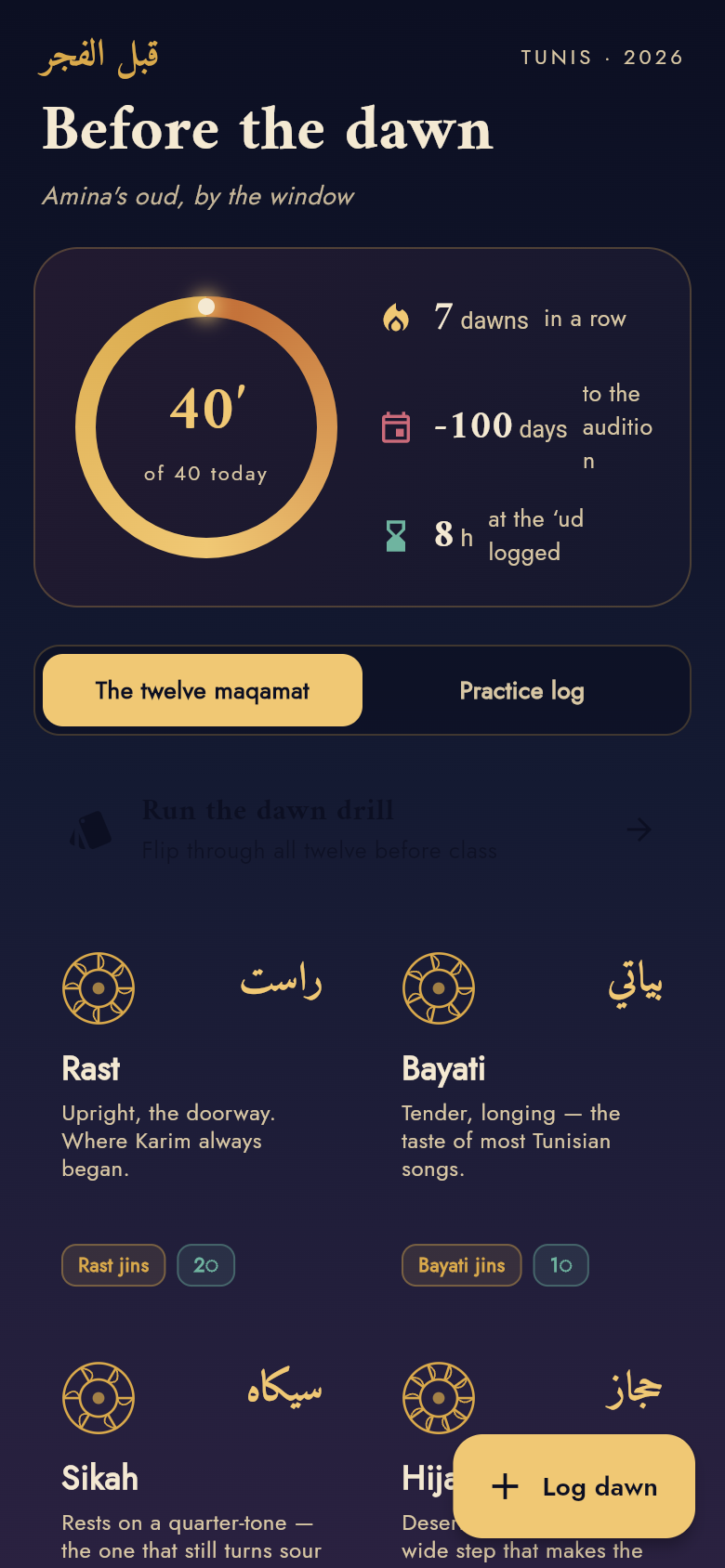
Every oud student knows the moment: it is five in the morning, the house is quiet, the instrument is in your hands, and you cannot quite remember whether Maqam Rast starts with a quarter-tone on the third degree or the second. You reach for your phone and end up in a rabbit hole of conflicting forum posts, three different transliterations, and a YouTube video that starts in the wrong octave.
Oud Maqam is a small, single-purpose app built to end that search. It holds all twelve maqamat in one offline reference, drills you on note sequences with flip cards, and logs each morning session against a countdown to the date that actually matters, the conservatory audition you have been working toward.
Live demo
One reference for all twelve maqamat
Maqam theory is scattered. Different teachers transliterate the same scale four different ways, and most written sources skip the quarter-tone degrees as if they are obvious. They are not obvious, and getting them wrong in an audition is the kind of mistake that is hard to walk back.
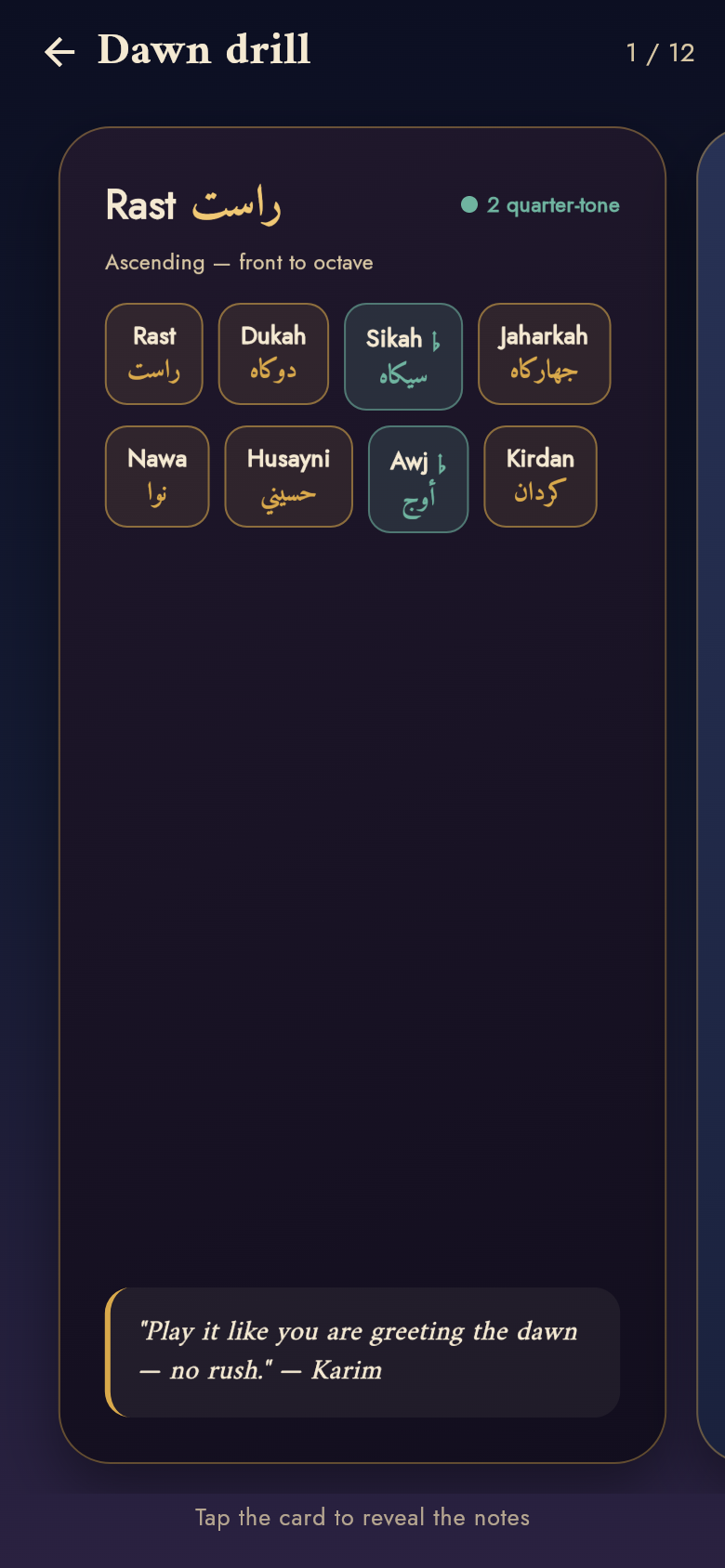
The app's reference screen lays each maqam out clearly: its ascending notes, the jins family it belongs to, its tonic position on the oud, and the exact degrees that carry a quarter-tone. Nothing is hidden behind a paywall or a network request. Open the app in airplane mode at five in the morning and all twelve maqamat are right there, seeded with real content from the first launch.
Flip-card drilling that tests real recall
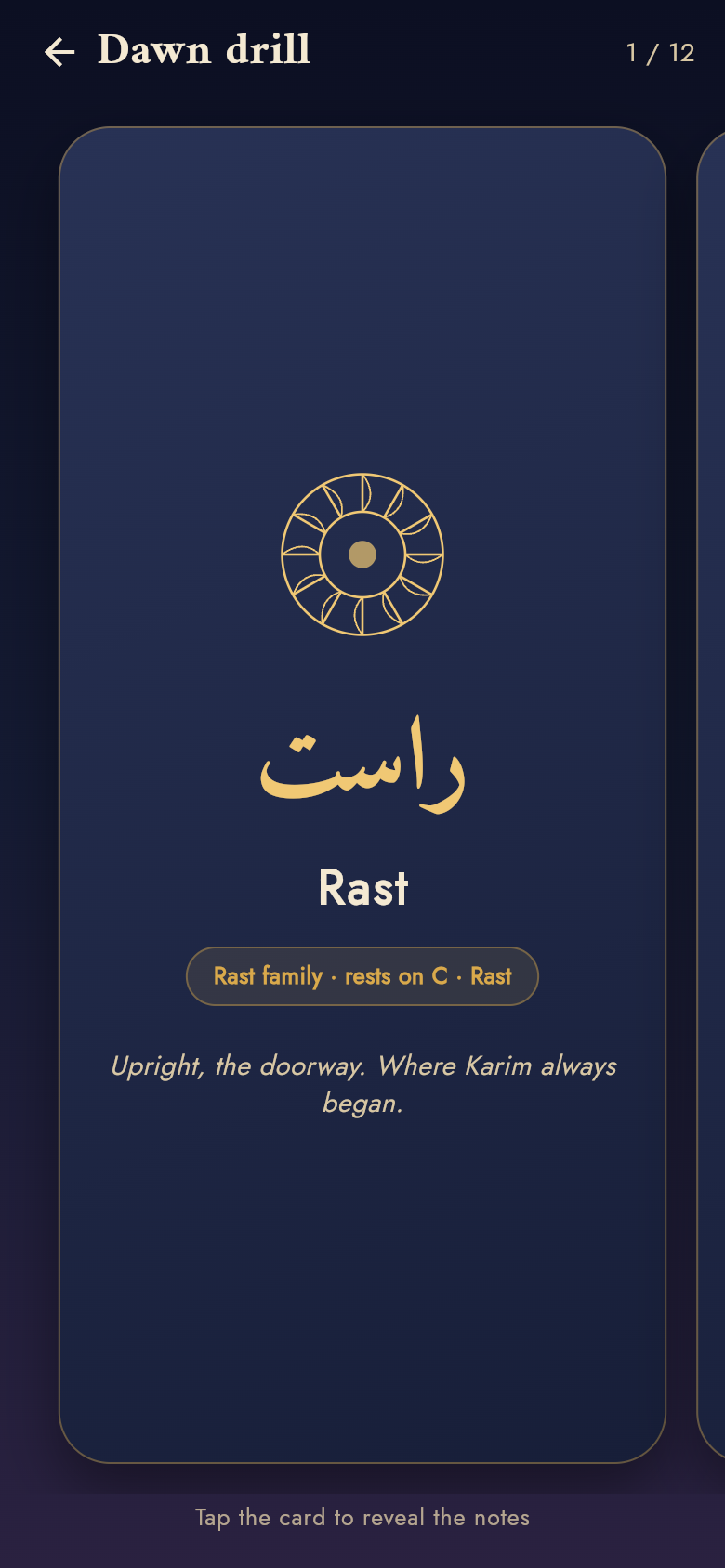
Recognising a maqam on a page and recalling its notes cold are two different skills. Conservatory auditions tend to test the second one. The drill mode presents each maqam by name, gives you a moment to run through it mentally, then flips to reveal the full ascending sequence with the quarter-tone degrees highlighted.
Try it in the embedded app above. Work through a few cards and you will quickly discover which maqamat you have genuinely internalized and which ones you have only half-memorised. That gap is exactly what a short daily drill session is designed to close over weeks, not days.
A practice log built around a real goal
Flashcard recall is only part of audition readiness. The bigger part is showing up every day. The practice log lets you record each session with the maqam you worked on, how many minutes you played, and a short reflection, the kind of note you might jot in a practice journal. A 40-minute dawn session is the target the app is calibrated around, and the streak counter makes consistency visible.
There is also a countdown to your audition date. It sits at the top of the log screen and does not let you forget what the practice is for. If you set the date the day you first open the app, every subsequent session carries a number that is one day smaller. That small pressure is useful.
Built for a specific person, not a generic student
The app was built with Amina in mind, an oud student in Tunis preparing for a spring audition on an instrument she inherited from her uncle. That specificity shaped every decision. The reference screen is not a textbook, it is the quick-lookup you need before a practice run. The log is not a productivity dashboard, it is a place to record that this morning's session on Maqam Sikah felt different from last week's.
Tools built around a real person's situation tend to feel warmer than tools built for an abstract user. You do not have to be Amina to get value from this app. You do need to be someone with an audition date, an instrument, and a specific set of scales to learn. If that describes you, the app fits.
From a one-line idea to a working app
The entire thing, reference data, flip cards, practice log, streak counter, countdown, was built from a single description of the problem. No months of product planning. No team of developers. The idea was specific enough to become a real tool quickly, and the result is an app that does exactly what was asked of it and nothing more.
If you have a similarly specific problem, a niche workflow, a personal practice routine, a reference you keep rebuilding from scratch, it is worth asking whether a focused app would serve you better than a general-purpose one. The prompt does not have to be long. It has to be honest about what you actually need.
39
files in the build
40.6 MB
app bundle
Flutter Web
runs in any browser
Have a tool you keep wishing existed?
Describe the problem you are trying to solve, who it is for, and what it needs to do. Leanfinit turns that description into a working app you can use right away.