
eczema
Leo's Skin: A Daily Eczema Log for Dermatology Visits
A pocket log that turns nightly eczema notes into a real flare chart, so your next dermatology review starts with data instead of guesswork.
Artem
Founder
· 5 min read
You know roughly how bad last Tuesday was, and you remember the awful week after the nursery trip, but when the dermatologist asks how many nights you reached for the steroid cream in the past month, the honest answer is often a shrug. Leo's Skin is a small, private app built for exactly this gap: a 20-second evening log that adds up, night by night, into the clear picture a specialist actually needs.
There is nothing complicated here. Each evening you rate the itch, mark which patches flared, and note what you used. The app does the counting. By the time your next appointment comes round, you have a real chart instead of a reconstruction from memory.
Live demo
Why a foggy recall is not good enough
Atopic eczema affects roughly one in five children, and most of that management happens at home, between visits that may be six or twelve months apart. A dermatology review is typically ten minutes long. The specialist wants to know how frequently you used the steroid cream, which body areas keep coming back, and whether the overall trend is improving or worsening. Parents genuinely want to answer well. The problem is that eczema fluctuates every few nights with triggers as unpredictable as a new washing powder, a bout of teething, or a hot bedroom, and human memory is not built to hold sixty nights of detail.
An objective count of steroid-versus-emollient nights is also genuinely reassuring in its own right. Many parents carry real anxiety about steroid use, and 'we used the cream eleven nights last month, mostly emollient the rest of the time' is a calmer, more grounded position than a nagging worry that you might have over-used it. Leo's Skin gives you that number without any extra work.
What the log looks like in practice
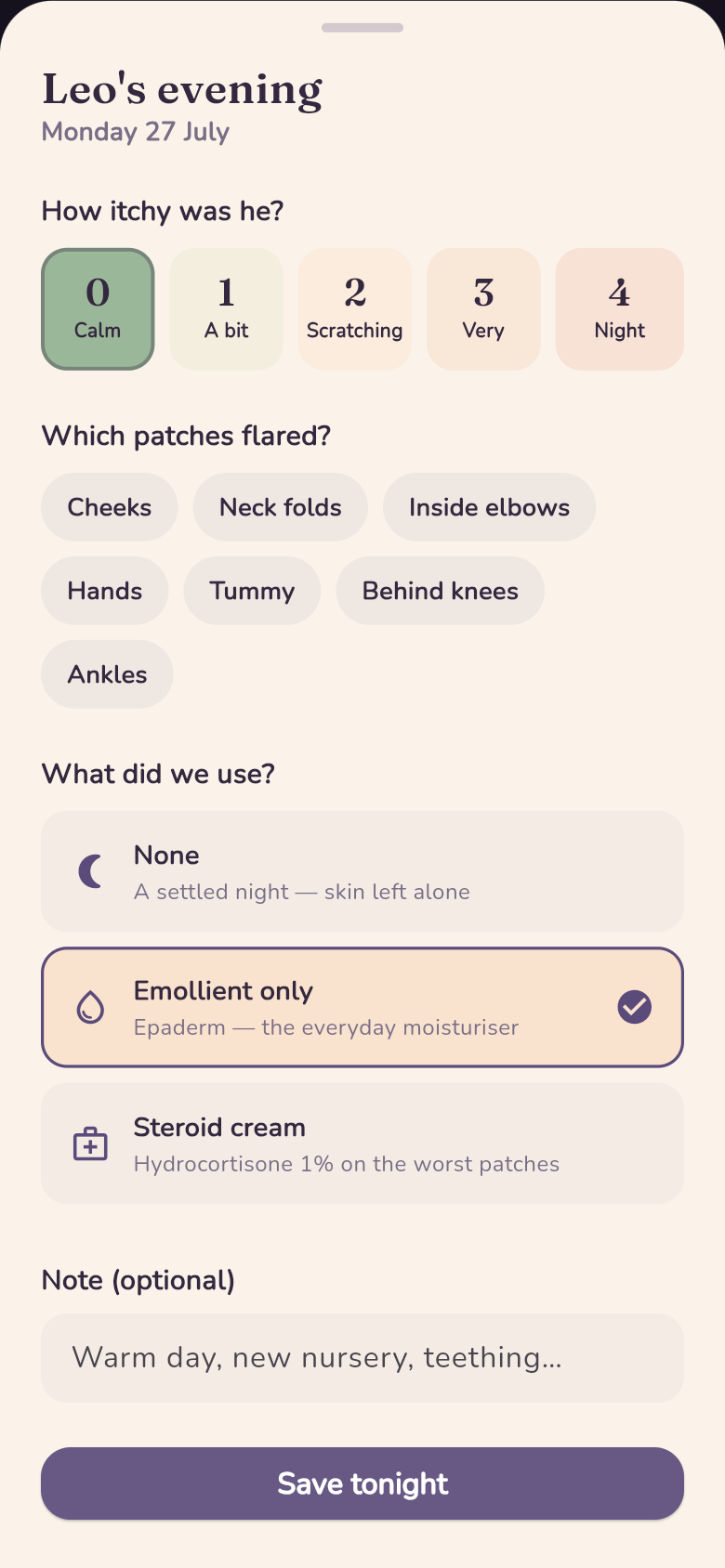
Try the live app embedded above. An evening log takes four taps: slide the itch severity to 0, 1, 2, 3, or 4; tick the body patches that were active (face, neck, elbows, knees, trunk, or hands); pick your treatment for the night; save. That is it. There is no free-text field to fill in, no account to create, and nothing leaves the device.
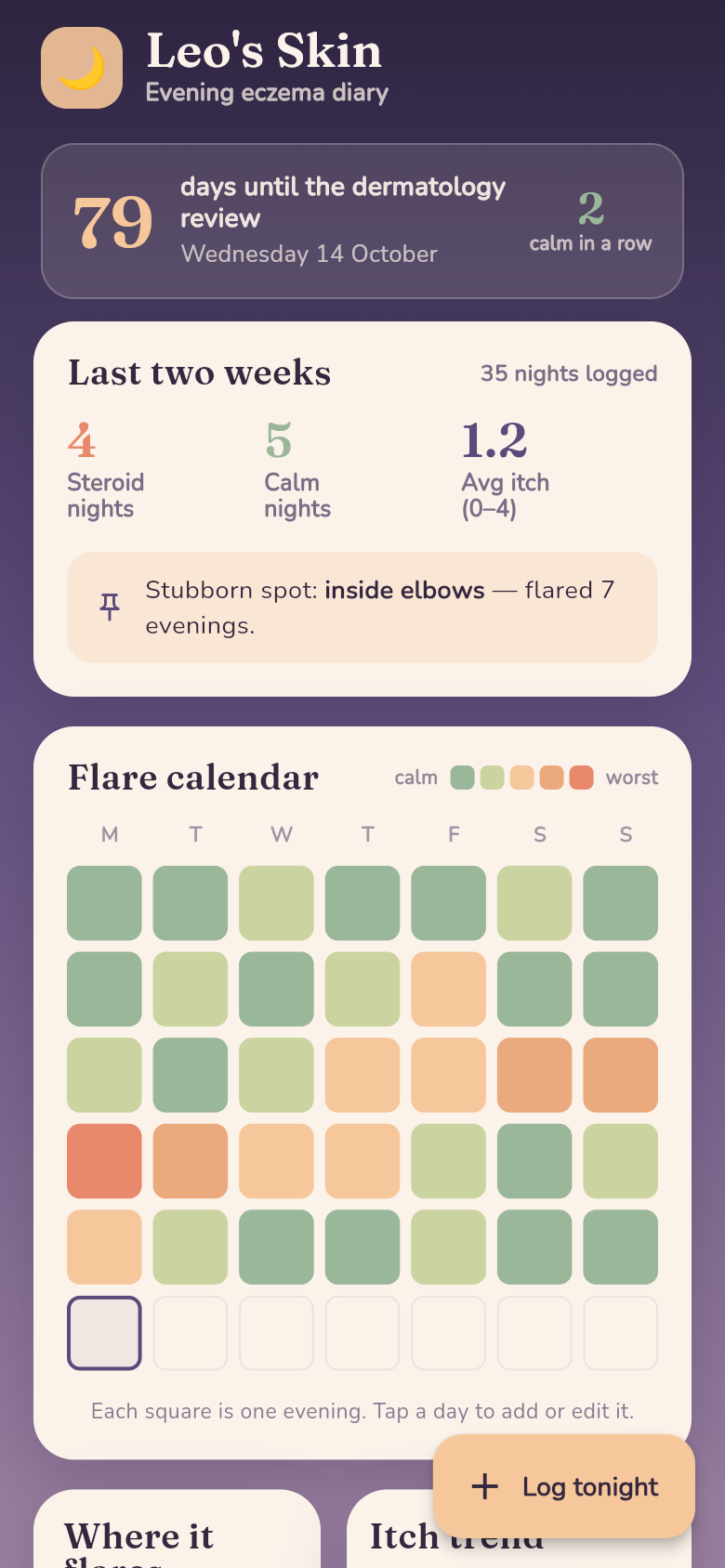
The flare calendar fills in as you go. Each day gets a colour that reflects severity, so a bad run of nights jumps out visually without you having to count backwards. This is the view to show the specialist first: it captures the rhythm of the condition, the gaps between flares, and the particularly rough spells in a way that words cannot.
The summary panel sits underneath. It shows the split between steroid-cream nights and emollient-only nights over the recent window, flags the most persistently affected patch, and draws a simple itch trend line. Most parents find the patch breakdown quietly useful: it is easy to under-notice that the back of the knees is always the one that flares last and stays longest.
Built around a real clinical conversation
The fields in the log were chosen because they map directly onto the questions a paediatric dermatologist or GP with a specialist interest will actually ask. Itch severity on a 0-to-4 scale aligns with validated scoring tools used in clinics. Treatment type matters because topical steroids and emollients work differently and the ratio matters for assessing control. Body location matters because certain patches indicate severity grades and influence treatment decisions.
This is not a diagnostic tool and it does not tell you what to do. What it does is help you arrive informed. A parent who can open a phone and say 'here are the last eight weeks' is in a much stronger position to have a useful ten-minute conversation than one who is apologising for not being able to remember.
Private by design
Child health data is sensitive. Leo's Skin stores everything locally on the device. There is no sign-in, no server, no sync, and no account recovery, which also means nothing to configure and nothing to worry about from a privacy standpoint. The trade-off is that if you switch phones you start fresh, but for a condition managed over weeks and months, a clean log on a new device is a minor inconvenience compared to the reassurance of keeping the data entirely offline.
If you want to share the log with a partner or a nanny who does the bedtime routine on some nights, the simplest approach is to use the same phone for logging. The app is light enough to live on a shared device without friction.
Walking into the appointment with something real
The next time a dermatologist or a GP asks about the past few months, you will not be guessing. You will have a calendar that shows the bad spell in week three, a count of how many nights you used the steroid cream, and a note that the left elbow crook has been the most stubborn patch. That is the kind of information that helps a specialist calibrate a treatment plan, adjust a steroid strength, or reassure you that things are actually trending in the right direction.
Leo's Skin started as a one-line idea, a simple request for a better way to prepare for one specific appointment. That is the whole point. You do not need a feature-heavy health platform to solve a focused, daily problem. You need something that fits into a bedtime routine without adding to it.
39
files in the build
40.5 MB
app bundle
Flutter Web
runs in any browser
Have a small problem that needs a focused tool?
Leo's Skin was built from a single idea in minutes. If you have a tracking or logging problem of your own, describe it and get a working app just like this one.